Parking has become a serious area of concern for businesses and drivers across the UAE, and the reason is simple. Dubai, Abu Dhabi and Sharjah have seen massive growth over the last decade. People are moving here, businesses are setting up here, and that growth brings a lot of good things with it. It also brings pressure on infrastructure that was never designed for this volume of vehicles.
This is not a UAE-only problem. Cities around the world hit the same wall at the same stage of growth. The advantage the UAE has is timing. We can see what happened to those cities before us, which means the problem can be solved proactively instead of reactively, and better parking infrastructure can be built for a much larger demographic before the situation becomes unmanageable.
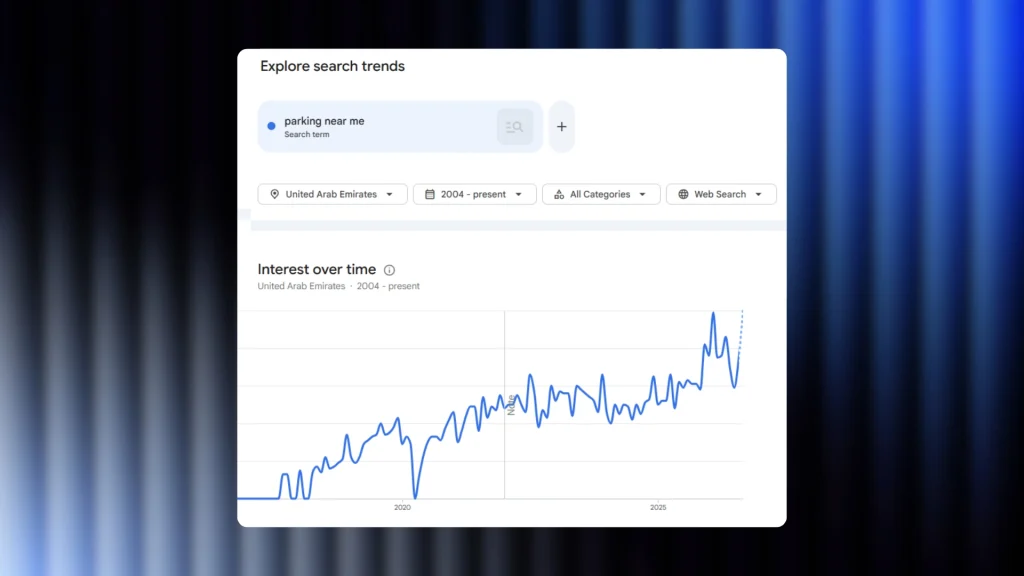
The market has been in an absolute uproar for the past few years. Google Trends shows search demand for parking spaces climbing steadily, which tells you two things. More people are looking for parking than ever before, and more revenue can be made from parking than at any point in the history of the UAE.
That is a real opportunity for parking lot owners, business owners, developers and technology companies to come together and deliver a world-class parking experience for the people of the UAE.
This guide is written for the people who have to make that happen. If you own or manage a car park, a mall, a tower, a hospital, a school, a labour accommodation, a beach club or a mixed-use community, and you are trying to work out which parking management system to sign with, this is the comparison you need. We have covered thirteen providers in detail, listed the rest of the market so nothing is missed, and given you the frameworks to run your own evaluation properly.
Why Choosing a Parking Management System Is Harder Than It Looks
Most buyers start this process thinking they are buying one thing. They are actually buying four, and the gaps between them are where projects go wrong.
A proper parking operation needs several separate pieces of hardware working together:
- ANPR cameras
- Automatic gate barriers
- Payment terminals and pay stations
- Handheld payment devices for staff
- Bollards and road blockers
- Parking guidance displays and LED signage
On the software side you need a system to track revenue, a system to process ANPR data accurately enough for the barrier to open reliably every single time, and a system to manage bookings, permits and visitor invitations. Depending on how the site operates, you will need validation logic for retail tenants, subscription handling for residents, valet workflows for hotels, and a reporting layer that finance will actually trust.
Then there is everything that happens on the ground before any of it goes live. The lot has to be prepared. There is trenching and cabling, power and network provisioning, mounting and alignment of cameras, multiple rounds of testing after installation, and signage placement. Running a parking operation end to end involves far more moving parts than most buyers expect when they start shortlisting vendors.
This is where the industry has a structural problem. A company might supply excellent software but have no capability to install hardware. Another might install the hardware but not handle the cabling and the civil works around it. A third might do both but rely on an overseas principal for every software change, which means a two-line tariff modification turns into a six-week ticket. The buyer ends up coordinating three vendors, chasing three support desks, and owning all the risk when something does not line up.
What the market actually needs is a fully managed solution that delivers the software layer, the hardware layer and the deployment layer as one accountable package. That is exactly what we do at Entry2Exit. We have our own on-ground staff in the UAE, our own hardware options, and parking software built for this region.
The Current State of the UAE Parking Technology Market
Before you compare vendors, it helps to understand what the market is actually made of, because the thirteen names below are not all the same kind of company. Putting them on one shortlist without understanding the difference is the single most common mistake in parking procurement.
There are four distinct types of player operating in the UAE right now.
Public concession operators. Parkin in Dubai and Q Mobility in Abu Dhabi hold regulated mandates over public parking in their emirates. They are technically sophisticated, and for most private buyers they are not a system you procure. They are a partner you negotiate with, and the commercial model is usually revenue share or management fee rather than a system purchase.
Private operators with their own technology. Parkonic, Secure Parking and GreenParking run car parks commercially and bring their own platform with them. The technology is real, but it usually arrives attached to an operating agreement. You are handing over the asset as much as buying software.
Hardware OEMs and their local channels. DESIGNA through KTC International, SKIDATA through Al Falak, Amano through Secure Parking, and locally manufactured CASS. These are equipment-first businesses with mature, proven lane hardware. Software behaviour is defined largely by the principal abroad, and customisation follows the OEM roadmap.
Software-first platforms and integrators. Entry2Exit, PARCX, Parkomax, TEKPark, VIGILANTE by SSK and Zone Parking Solutions. These build the intelligence layer and connect it to whatever hardware makes sense for the site. This is the group where flexibility and cost efficiency live, and where the quality range is widest.
Knowing which category a vendor sits in tells you more about how the project will run than any feature list will.
The Hardware Brands You Will Encounter
Most UAE sites already have equipment on the ground, and any credible system needs to work with it.
For cameras, the market runs mainly on Dahua, Hikvision, ISS, SSK, Hanwha and a handful of smaller brands, with specialist ANPR hardware from Adaptive Recognition and PIPS appearing on larger installations.
For automatic barriers, you will typically find Came, BFT, Nice, FAAC, Amano, DESIGNA and SKIDATA lane equipment, again with several smaller names in the mix.
Those two categories are the major hardware requirements for parking. Payment providers are the third, and there are several credible options in the region, from card acquirers and QR wallets through to Salik and Nol integration.
The point to take away is this. A proper parking management system should integrate with whatever combination the customer already has or wants. That should be a key priority when evaluating any parking management system in the UAE, because it is the single factor that decides whether you are buying a software layer or quietly buying a full hardware replacement you never budgeted for.
The Best Parking Management Systems in the UAE
1. Entry2Exit
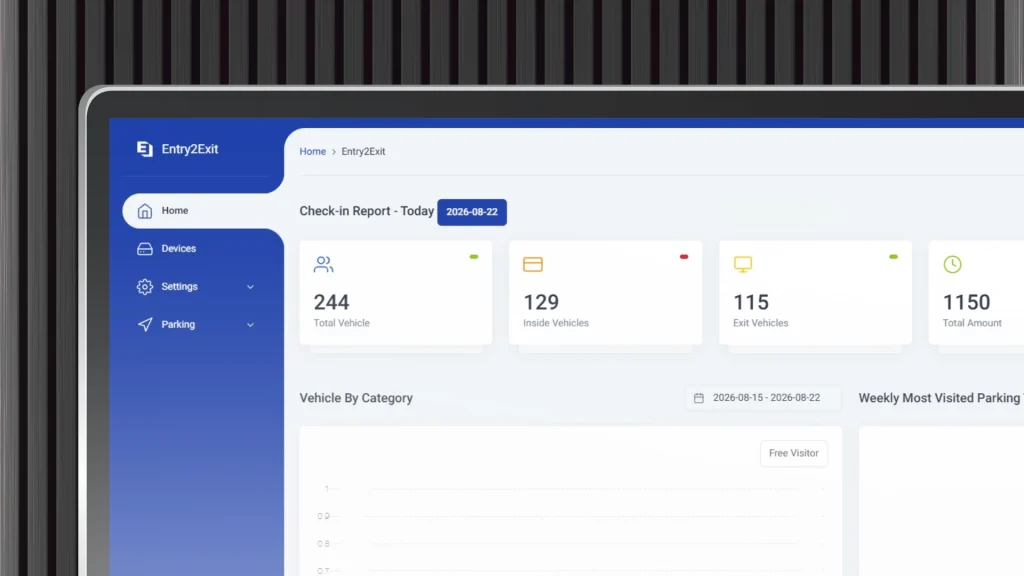
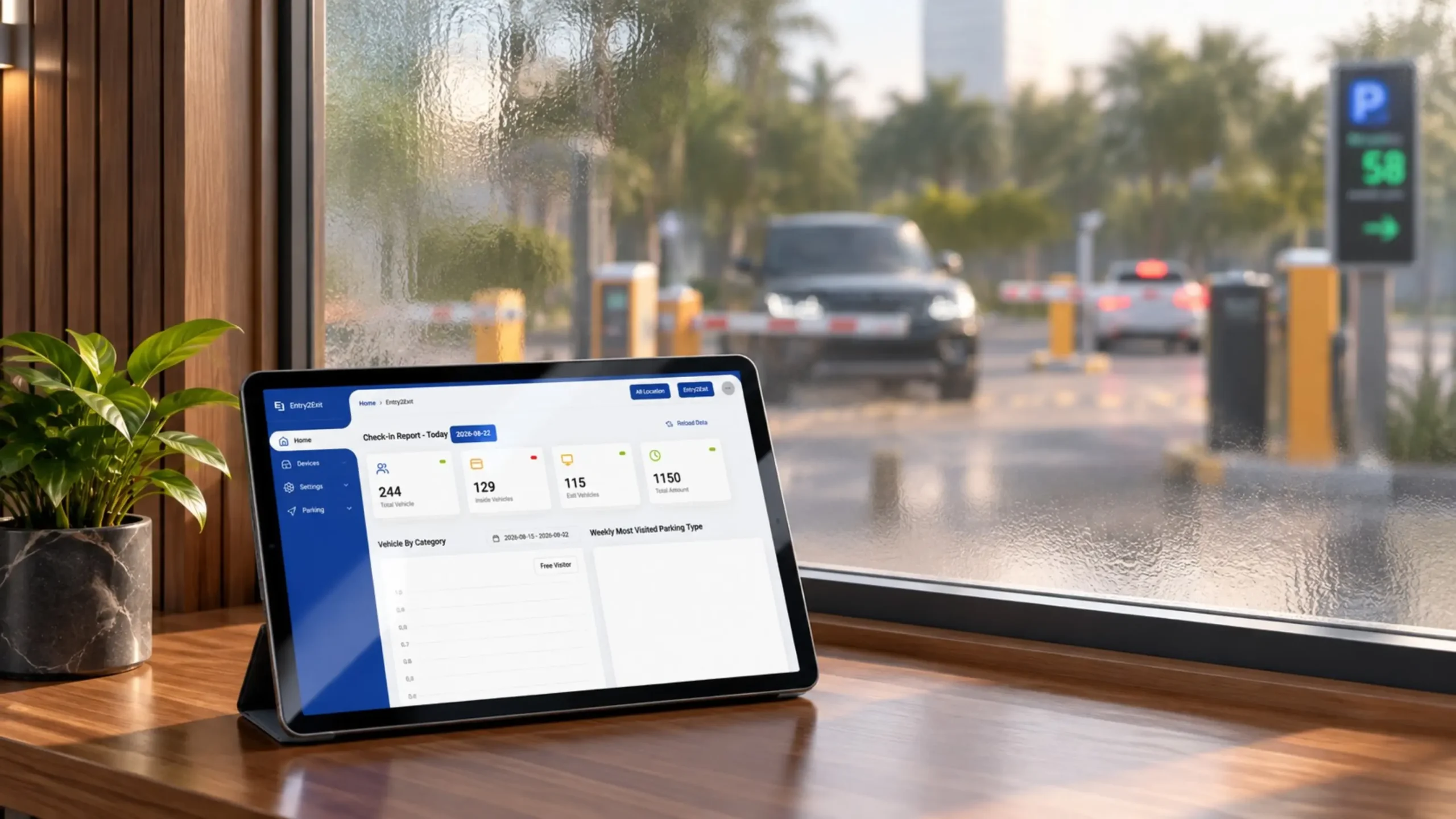
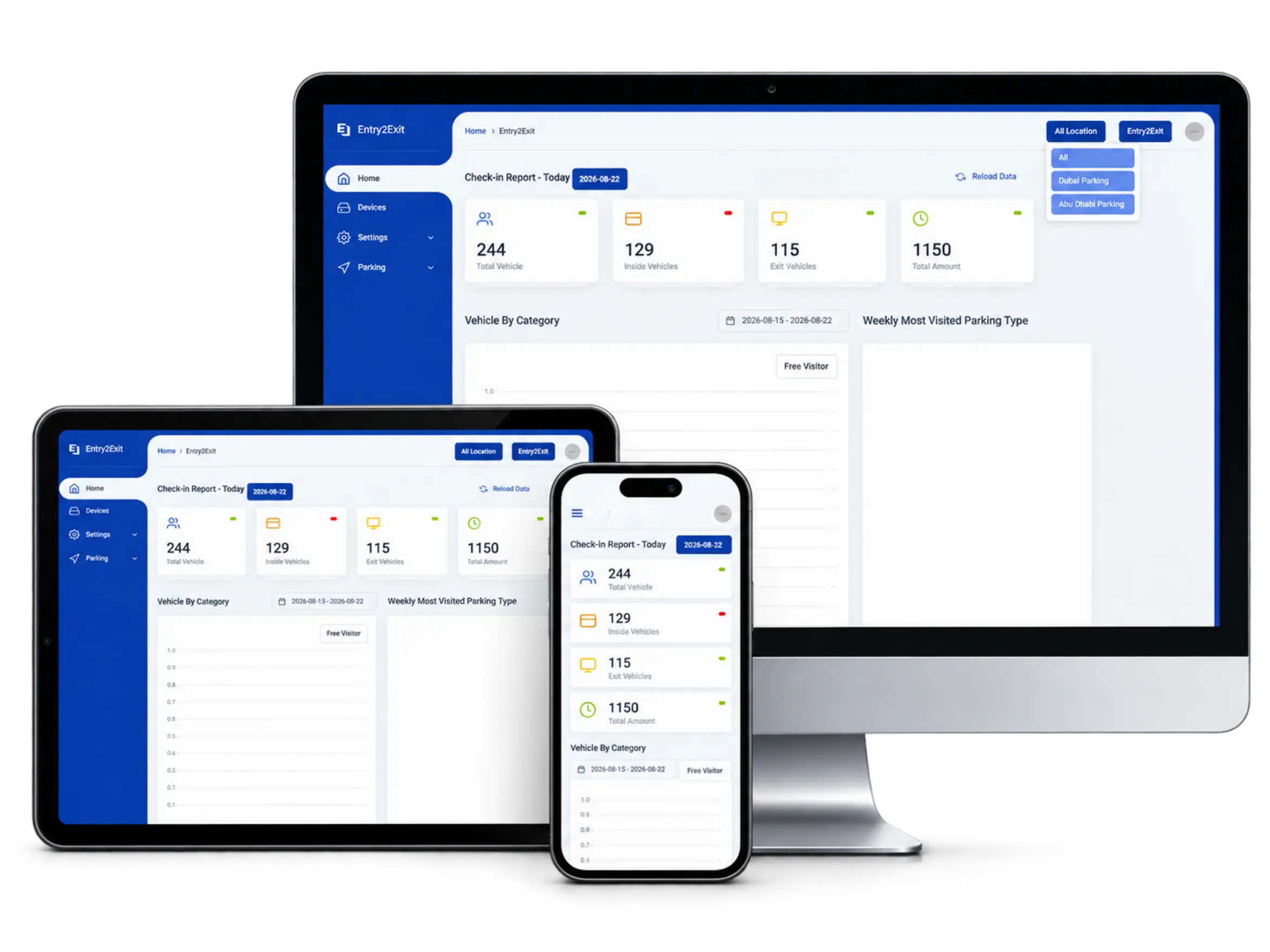
Entry2Exit is a UAE-built parking management platform that covers the software layer, the hardware layer and the deployment layer as a single accountable solution. It is one of the only providers on this list that genuinely offers end-to-end solutioning, which in practice means Entry2Exit takes responsibility for the software, for any customisation or integration required around it, and for the physical work of getting the system live on your site. The platform runs ANPR-based entry and exit, gated or barrierless, alongside reservations, visitor invitations, tenant and staff mapping, validation and free-parking rules, approval workflows, parking guidance, LED displays, EV charger integration and a full analytics dashboard. The company operates from Dubai with its own on-ground staff across the UAE, and the wider brand has delivered more than 150 projects in the country with a partner ecosystem built to support almost any combination of requirements.
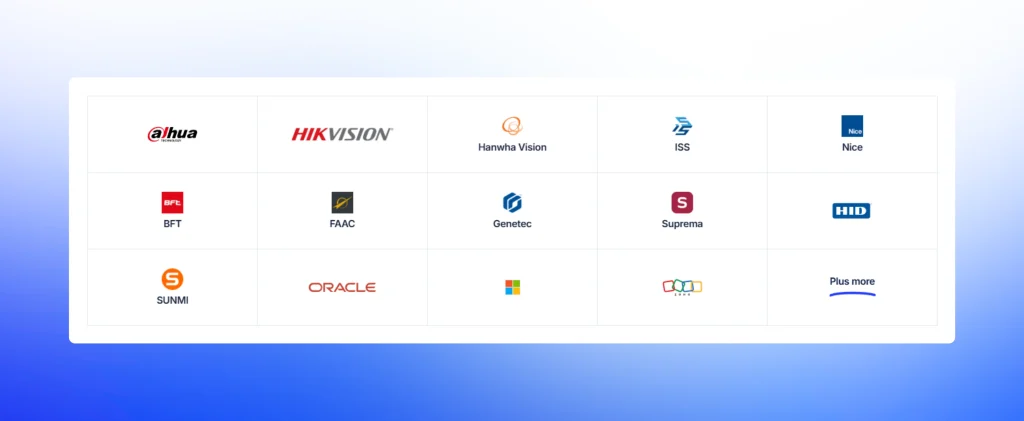
The real differentiator is the integration ecosystem, and this is where the practical value shows up on a quotation. Entry2Exit is brand-agnostic by design and has already built working integrations with the equipment this market actually runs on. If a customer wants their existing Dahua ANPR cameras used with their existing Nice barriers, that works. If they want a new thermal or heat-vision camera paired with existing Came barriers, that works too. Any combination can be integrated, because the integration layer already exists for Dahua, Hikvision, ISS, SSK, Hanwha, Nice, Came and BFT, alongside access control platforms such as Suprema and Genetec, and enterprise systems including Oracle, Microsoft, Azure, Salesforce, Zoho and HID.
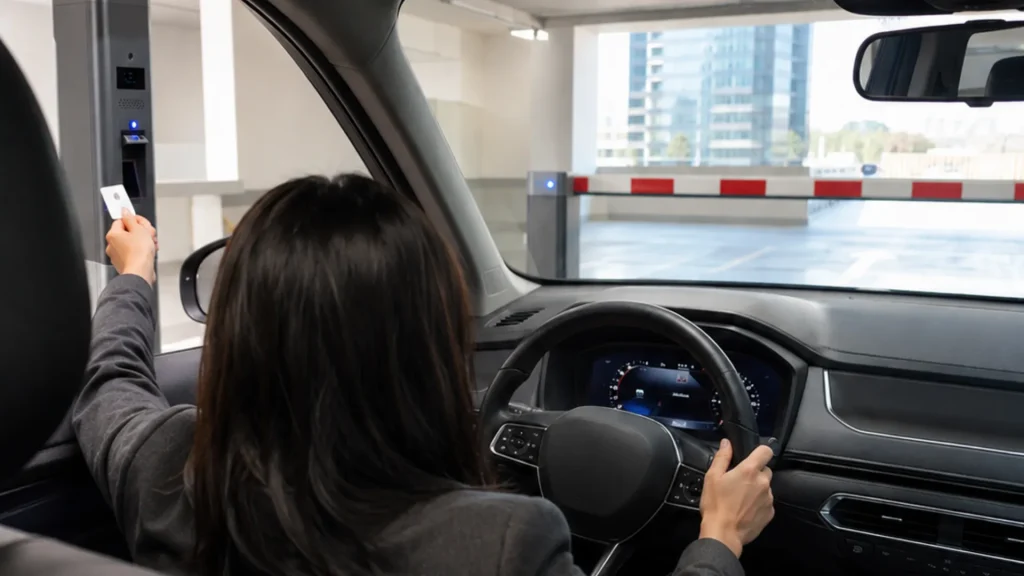
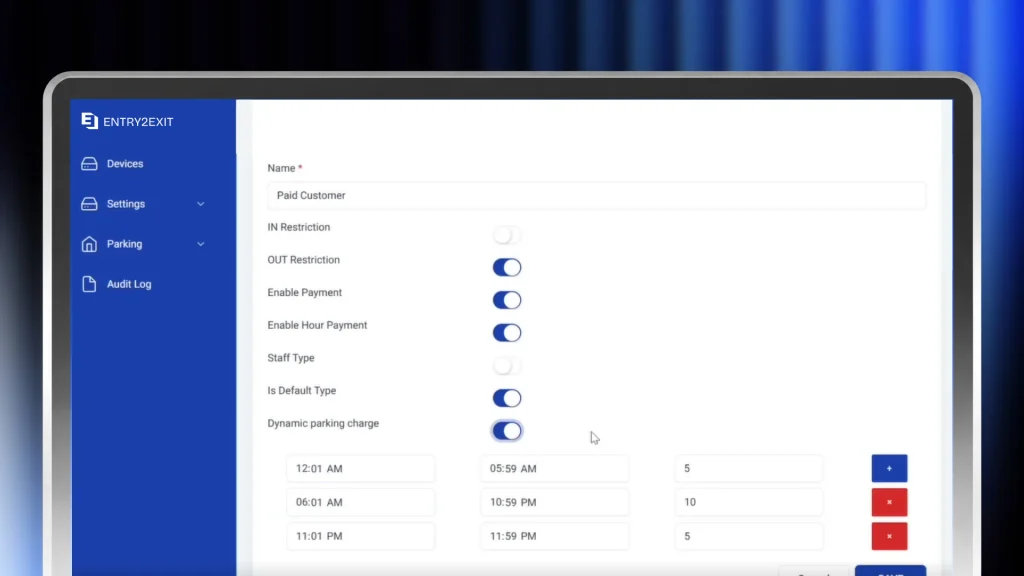
On payments, We use Entry2Exit’s own payment solution which supports QR code payment, Apple Pay, Google Pay, Samsung Wallet, tap and go contactless cards, standard card payments and cash collection through handheld POS devices with on-the-spot receipt printing. There is a mobile app that is customised to each customer’s requirement, in-house kiosk hardware that is already integrated with the payment stack, and number plate recognition tuned specifically for GCC plate formats, which is where most imported ANPR engines lose accuracy. Deployment is equally flexible, with on-premise servers, a private customer-owned cloud, or a fully managed cloud server, so IT and security teams are not forced into a hosting model they are not comfortable with.
Where Entry2Exit separates itself from almost everything else in this comparison is that it does not sell a boxed product. The team studies the requirement, the existing processes and the infrastructure already installed, and then designs the solution around them. For any site with existing cameras, barriers or controllers, this is where the cost difference becomes obvious, because the software layer simply comes on top and manages everything without a hardware replacement. Delivery is backed by on-ground staff for installation support, technical support and training, plus online support and remote assistance for anything that does not need a site visit.
Notable parking deployments include projects for Nshama, Umbrella Beach in Fujairah, mall and commercial projects including Q1 Mall and The Curve Building, Magnum opus Tower and more. The broader Entry2Exit customer base spans GEMS Education, Talabat, Mai Dubai, Marriott, St Regis, Hilton, Dubai World Trade Centre, DP World, ADNOC, Al Futtaim, Chalhoub Group, CEVA Logistics and Fujairah Oil Terminal, with the platform serving over five million visitors across more than four countries. If you want one contract, one support number and a system shaped around your operation rather than the other way round, this is the strongest option on the list.
Integrations at a glance: Oracle, Microsoft, Salesforce, Zoho, Microsoft Azure, HID, Hikvision, Dahua, Suprema, Genetec, ISS, SSK, Hanwha, Nice, Came, BFT, Apple Pay, Google Pay, Samsung Wallet, plus any custom integration required.
Pros
- True end-to-end delivery covering software, hardware and on-ground deployment under one contract
- Deep, already-built integration ecosystem across the camera, barrier and access control brands used in the UAE
- Works with existing infrastructure, which removes hardware replacement cost on retrofit projects
- Full payment coverage including QR, Apple Pay, Google Pay, Samsung Wallet, tap and go, cards and handheld POS with receipt printing
- ANPR tuned for GCC plate formats rather than adapted from another region
- Own kiosk hardware already integrated with the payment stack
- Customised mobile app per customer instead of a fixed consumer app
- On-premise, private cloud and managed cloud deployment options
- UAE-based team with local installation, training, technical support and remote assistance
- Genuine customisation of workflows, interface and business logic rather than configuration inside a fixed product
Cons
- Not a public parking operator
- No revenue share based model
- Pricing is quotation based, so there is no published list price to benchmark against before an initial conversation
2. Parkin
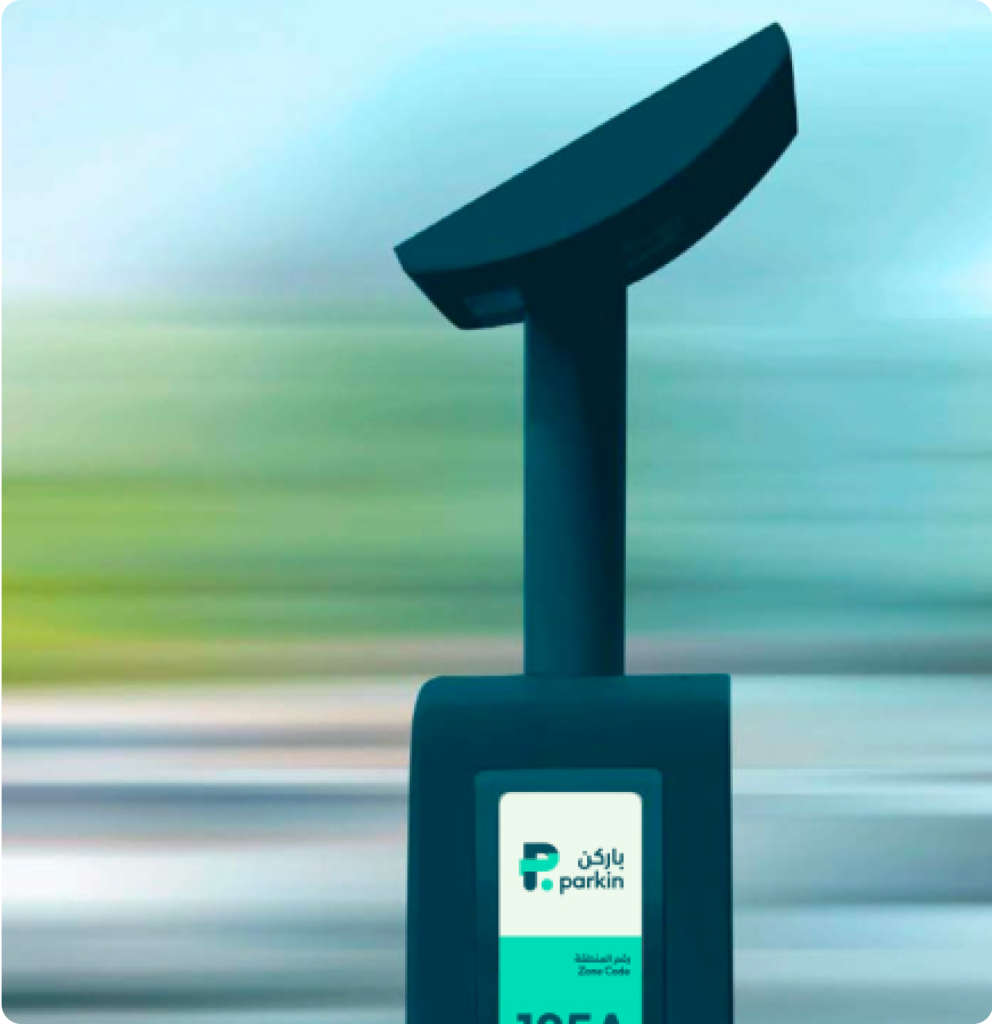
Parkin is Dubai’s public concession operator, and it sits in a category of its own on this list. It is not simply a software vendor. Parkin Company PJSC is a government-created, publicly listed business that operates as a developer, a parking operator and an enforcement platform, and it owns and operates the RTA-derived parking software and IP under a 49-year concession agreement. Its scale is genuinely difficult to compete with. The portfolio stood at roughly 229,000 paid spaces at the end of 2025 and reached around 268,300 spaces by the middle of 2026, split across public on-street and off-street parking, multi-storey car parks and a fast-growing developer parking segment. Technology partnerships include Hikvision, and the platform reaches drivers through the Parkin app, SMS, WhatsApp, Nol, Apple Pay and card payments, with cashless transactions running at roughly ninety percent.
Operationally, Parkin has moved aggressively into the areas the rest of the market is still catching up on. It runs barrierless, ticketless parking at Oud Metha and on behalf of Majid Al Futtaim across Mall of the Emirates and City Centre properties, and the refurbished Al Rigga multi-storey reopened with barrierless access technology. AI-driven enforcement has been deployed at Dubai Mall, Dubai Hills Mall and Marina Mall, and the company has been testing roof-mounted smart scan car camera systems designed to reduce on-foot inspection in congested areas. The developer parking business has more than tripled to over 61,500 spaces through partnerships with Dubai Holding, DP World, Dubai Sports City, Binghatti and others, and in 2026 Parkin signed a strategic partnership with Secure Parking targeting a pipeline of more than 60,000 barrierless spaces, plus its first expansion outside Dubai with Arada at Aljada in Sharjah. There is also an EV partner ecosystem for charging, and exploratory activity in Egypt.
For a private buyer, the honest read is this. Parkin is exceptional at what it does, but it is not a system you can procure competitively and own. You cannot buy Dubai public-parking rights, and for developer parking you are entering an operating partnership where Parkin runs the asset, sets much of the customer experience and takes a commercial position in your revenue. That is an excellent outcome for some owners, particularly large residential developers who want the parking problem to disappear entirely and are happy for drivers to use the Parkin app. It is the wrong outcome for owners who want to control their own tariffs, branding, validation logic and data, or who need the system to integrate tightly with a building management platform, a hotel PMS or a tenant portal. The camera and barrier bill of materials is also not fully public, which makes technical comparison against a conventional vendor difficult. Evaluate Parkin as an operator and a partner, not as a product on a shortlist.
Pros
- Unmatched scale in Dubai with roughly 268,300 spaces under management
- Deep integration with the RTA ecosystem, Nol and the wider Dubai mobility infrastructure
- Mature consumer app with SMS, WhatsApp, Apple Pay and card payment options
- Proven barrierless and ticketless deployments at high-traffic sites
- AI-driven enforcement capability that few private vendors can match
- Strong financial position as a listed company, which reduces counterparty risk
- Handles permits, subscriptions, enforcement and payments in one platform
- EV charging partner ecosystem already in place
Cons
- Not a system a private buyer can procure, own or deploy independently
- Commercial model is a concession or operating partnership, so you give up a share of revenue and control
- Limited ability to customise tariffs, branding, validation rules and workflows to your own operation
- Hardware bill of materials is not publicly documented, which limits technical comparison
- Drivers are pushed into the Parkin ecosystem rather than your own brand experience
- Relevance drops sharply outside Dubai and outside the public and developer parking segments
3. Parkonic
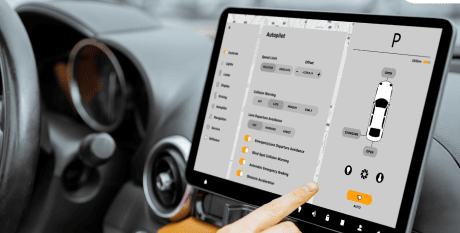
Parkonic, a subsidiary of the UAE-based Valtrans Group, is the largest private parking operator in the country and the most visible commercial force in barrierless parking. It runs its own PARKONIC OS platform across several delivery modes: Free Flow barrierless parking, hybrid gated setups, on-street parking, residential schemes, Gate Access, Space Share and retail validation. The technology claims are aggressive, including sub-0.3-second plate detection and 99.9 percent recognition accuracy, supported by AI LPR, on-street IoT sensors and a cloud management portal. Payments run through the Parkonic app and wallet, Salik, tap and go, QR, SMS, and credit and debit cards, with cash and card terminals where a site needs them.
The portfolio is the strongest argument in Parkonic’s favour. The company operates more than 150 parking locations across the UAE, including the Museum of the Future, Dubai Harbour, Palm West Beach, WAFI Mall, Souk Al Bahar, Global Village, The Beach at JBR, Sheikh Shakhbout Medical City, Saadiyat Beach in Abu Dhabi, Al Qasba in Sharjah and sites in Fujairah. The Salik relationship is the real strategic asset. Since 2024 Parkonic has integrated the Salik eWallet as its preferred payment channel, and in August 2025 the two companies announced a landmark partnership with Dubai Holding to roll out fully autonomous, AI-powered on-street and off-street parking across more than 36,000 spaces. At WAFI Mall the model is now fully ticketless with tickets, cash and pay machines removed entirely, plate scanning on arrival, QR settlement on site and automatic Salik deduction on exit if the driver has not paid. Parkonic also lists activity in Egypt, Saudi Arabia, Qatar, the USA and the UK.
The trade-off is the same one that applies to any operator-led model, and it is a significant one. Parkonic is primarily an operator, not a vendor selling you a system to run yourself. Engaging with them usually means handing over the operation of your car park and accepting their commercial terms, their driver experience and their app. That works well for retail and destination assets where footfall monetisation is the goal and the owner has no appetite to run parking. It works poorly for corporate campuses, hospitals, schools, industrial facilities and residential towers where parking is an access control and security function rather than a revenue business, and where the system needs to talk to visitor management, HR databases or building systems. The performance figures are also vendor claims rather than independently audited numbers, and device OEMs are generally not disclosed, so anyone evaluating Parkonic on technical grounds should request audited UAE-plate accuracy data, offline continuity behaviour and API documentation before committing.
Pros
- Largest private parking network in the UAE with more than 150 live locations
- Genuine, proven barrierless Free Flow capability at scale
- Deep Salik integration, which removes friction for a large share of UAE drivers
- Strong roster of landmark destination sites
- Multiple delivery modes covering free flow, hybrid gated, on-street and residential
- Retail validation APIs and property system integrations already in place
- Regional and international presence beyond the UAE
Cons
- Primarily an operator model, so you are outsourcing the asset rather than buying a system
- Limited control over tariffs, branding and the driver-facing experience
- Hardware OEMs and device models are generally undisclosed
- Accuracy and detection speed figures are first-party claims without published independent verification
- Weaker fit for corporate, healthcare, education and industrial sites where parking is a security function
- Commercial terms are opaque until you are deep in a negotiation
4. Q Mobility
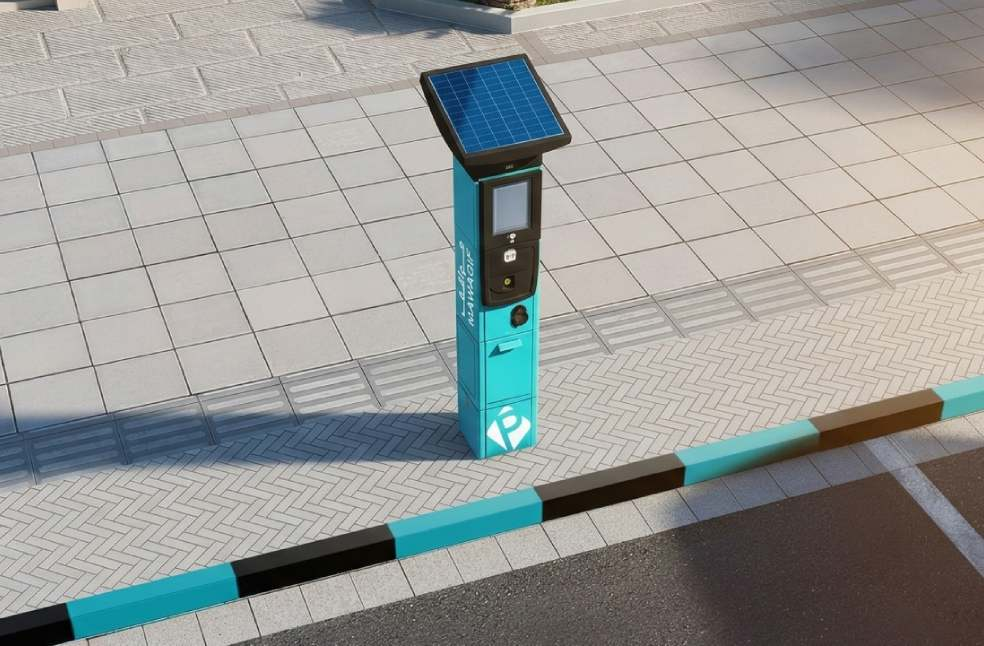
Q Mobility LLC, established by ADQ, is the Abu Dhabi equivalent of Parkin. It operates Mawaqif public parking and the Darb toll network across the emirate, which makes it a government mobility company rather than a conventional supplier. Its remit covers on-street public parking, multi-storey car parks, permits, resident and villa parking schemes, and enforcement, with published tariffs of AED 2 per hour capped at AED 15 per day in standard zones and AED 3 per hour in premium zones with a four-hour maximum stay. Multi-storey parking runs at AED 2 per hour with the same daily cap, and subscription permits are published transparently, running from roughly AED 1,369 for three months up to AED 5,475 for a year depending on category.
Technically, Q Mobility has been moving quickly. Mawaqif Free Flow, unveiled as Zero Barrier AI Parking at GITEX Global 2025, is a UAE-made, AI-powered, fully touchless system that uses smart cameras for plate detection, automated payment handling and real-time traffic management connecting public and private parking areas. The system is solar powered, and in June 2026 Free Flow was activated across Abu Dhabi’s multi-storey parking buildings with automatic fee deduction through the Darb wallet. Payment channels include Darb auto-debit, QR and web payment for vehicles without a Darb account, SMS, and parking meters accepting coins, cards and rechargeable cards. Fines flow through TAMM. A collaboration with Parkin has also been announced, which suggests the two emirate operators are moving toward a more connected national picture.
The buyer reality mirrors Parkin. This is not a supplier catalogue you can procure from in the normal sense. Hardware brands, system licensing terms and the commercial model for private sites are not public, and the organisation is structured around a regulated emirate-wide mandate rather than around selling and supporting systems for third-party landlords. If your site is in Abu Dhabi and sits inside or adjacent to the Mawaqif regime, you will need to work with Q Mobility regardless of what else you buy, particularly on tariff alignment and enforcement. If you are a private owner looking for a system you control, Q Mobility should be treated as an ecosystem you integrate with rather than a vendor you shortlist. The relevant question to ask any private vendor is whether they can support Darb wallet settlement and coexist cleanly with the surrounding Mawaqif zones.
Pros
- Emirate-wide authority and infrastructure across Abu Dhabi
- Transparent, published end-user tariffs and permit pricing
- Mawaqif Free Flow is a genuine, live barrierless deployment across multi-storey facilities
- Darb wallet gives frictionless automatic payment for a large installed base of drivers
- Solar-powered infrastructure supports sustainability reporting requirements
- Integration with TAMM for fines and government services
- Announced collaboration with Parkin points toward a joined-up national ecosystem
Cons
- Not a conventional supplier, so private procurement is limited and non-standard
- Hardware brands, models and licensing terms are not publicly disclosed
- No meaningful customisation for individual private sites
- Scope is confined to the Abu Dhabi emirate
- Commercial model for private facilities is not published
- Cannot be evaluated on the same criteria as a technology vendor
5. CASS
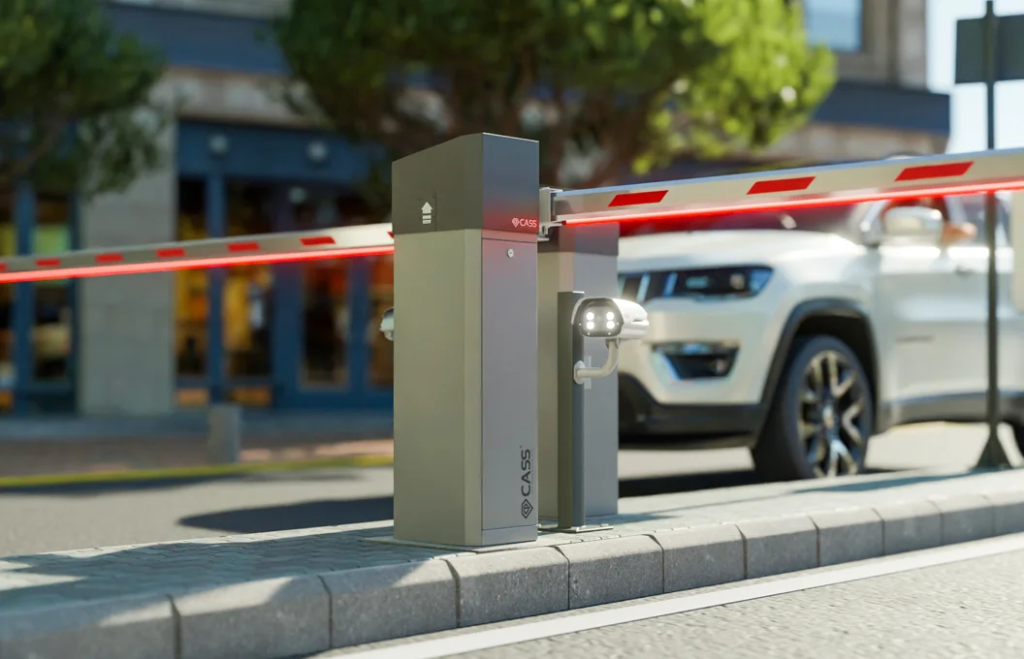
CASS Parking Equipments Factory LLC is a Dubai-based manufacturer, and that single fact makes it different from almost everyone else on this list. Rather than importing a European or Japanese platform and localising it, CASS builds its own parking hardware in the UAE and supplies the software alongside it. The product range is unusually well documented for a local firm. It includes CP-020X, CP-030X and CP-060X boom barriers, CP-2100 pay stations that accept notes, cards and wireless payment, lane terminals, ticket and token dispensers, card readers and manual cashier positions. On the detection side there is the CP-900A ANPR camera with RECO recognition software, the CP-VISIO 2.1 AI camera sensor that can cover up to six bays and read plate numbers, CP101 ultrasonic sensors and CP-105 wireless magnetic and radar sensors for guidance applications.
That vertical integration produces some real advantages. Because CASS manufactures locally, spares are available in-country, lead times on replacement barrier arms and boards are shorter than they would be for an imported system, and the commercial structure has no principal margin stacked on top. The system range covers ticket-based, token-based and ticketless parking, parking guidance with car-finder functionality, smart-city and on-street applications, access and visitor management, RFID and UHF long-range reading, and under-vehicle surveillance systems. Payment support includes validation, cashier operation, notes, cards and wireless. Reference projects are substantial and verifiable, including Cleveland Clinic Abu Dhabi, NAS Mall, Canadian Hospital, Emaar Business Park B3, Zabeel Park, Dubai Creek Harbour multi-level car park and the Emirates NBD parking building, with export references in India, Sri Lanka, Kenya, Kuwait, Oman, Saudi Arabia, Bahrain, Jordan and parts of Africa.
The limitation is philosophical as much as technical. CASS is a hardware company that also supplies software, and the centre of gravity shows. The strongest reason to choose CASS is that you want CASS equipment, which means the value proposition weakens considerably on a retrofit where you already have Dahua cameras and BFT barriers installed and working. Third-party integrations are supported, but the system is designed around its own product family rather than built as a neutral layer over anyone else’s. Software sophistication in areas like tenant portals, approval workflows, dynamic validation, guest invitation flows and analytics is generally a step behind the software-first platforms. And while the public hardware disclosure is the best among local firms, buyers should still request current certifications, production origin by SKU and independent accuracy and MTBF data rather than accepting datasheet figures.
Pros
- Genuine UAE manufacturer with in-country production and spares availability
- Best public hardware disclosure of any local provider, down to specific model numbers
- Full physical range covering barriers, pay stations, terminals, cameras and sensors
- Shorter lead times and no imported principal margin
- Strong verifiable reference projects across healthcare, retail and commercial
- Supports ticket, token and ticketless modes plus guidance, RFID and UHF
- Export track record across the GCC, Asia and Africa
Cons
- Hardware-centric, so the value case weakens sharply on retrofits with existing equipment
- Software depth in workflows, tenant management and analytics trails the software-first platforms
- Designed around its own product family rather than as a brand-agnostic layer
- Independent accuracy and reliability data is not published
- Less compelling if you want a single platform managing mixed-brand infrastructure across multiple sites
- Certifications and production origin need to be verified SKU by SKU during procurement
6. Parkomax
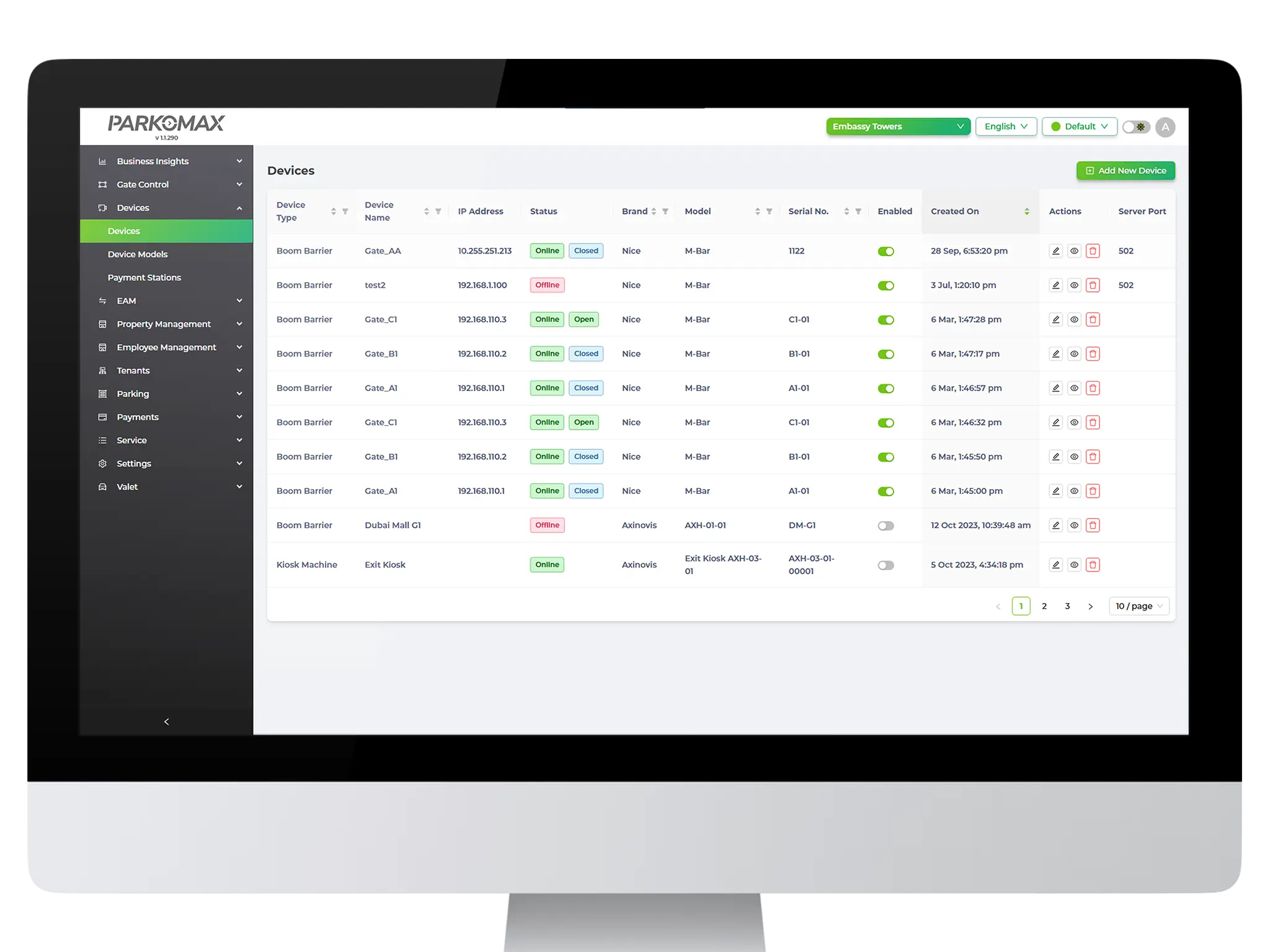
Parkomax Middle East LLC is a Dubai-headquartered software vendor and systems integrator with its own parking and access platform. The product covers ticketless and gated parking management, access control for visitors, employees and residents, pre-booking, parking guidance systems, find-my-car functionality and surveillance integration. The technical positioning is integration-led, and Parkomax has published specific, verifiable integrations rather than vague compatibility claims, most notably with Axis for ANPR and Paxton for access control. Beyond that the platform handles QR and RFID credentials, booking flows, LED guidance, bay sensors and a multi-site dashboard, and the company has published use cases involving flight schedule data, which points to airport or hospitality applications.
Project references are reasonably diverse. Parkomax has documented an automated parking access and payment deployment at UW Mall in Al Mankhool covering two barriers with ANPR and auto-pay, parking management for Dubai Courts and Dubai Traffic Police, work at Mirdif Hills Avenue Mall, Radisson DAMAC Hills and a leading but unnamed Dubai hospital. The company is also distributed through regional security integrators such as Stebilex, which extends its reach into projects where the primary relationship sits with an ELV contractor rather than directly with Parkomax. For mid-sized commercial and mixed-use sites where the requirement is a competent ticketless system with clean access control integration, Parkomax is a credible and frequently shortlisted option.
Where buyers should apply pressure is on ownership and accountability. Most project descriptions and technical claims are first-party, barrier OEMs are not consistently disclosed, and the distribution model through third-party integrators means the entity you sign with may not be the entity that owns the software. That matters when you need a customisation, because your change request has to travel through a channel partner before it reaches the development team. The published integration list is also narrower than the ecosystem a UAE retrofit typically demands. Axis and Paxton are excellent, but if your site is running Dahua cameras with Came barriers and Suprema readers, you need explicit written confirmation rather than a general assurance of compatibility. Confirm software ownership and licensing terms, identify who holds support escalation, and get the barrier OEM named per bid.
Pros
- Dubai-headquartered with its own proprietary platform rather than a resold product
- Documented, specific integrations with Axis ANPR and Paxton access control
- Covers ticketless and gated modes, pre-booking, guidance and find-my-car
- Government and public sector references including Dubai Courts and Traffic Police
- Multi-site dashboard suitable for portfolio operators
- Available through regional security integrators, which widens delivery capacity
Cons
- Project descriptions and performance claims are largely first-party
- Barrier and camera OEMs are not consistently disclosed
- Distribution through third-party integrators can blur software ownership and support escalation
- Published integration ecosystem is narrower than a typical UAE retrofit requires
- Customisation requests may route through a channel rather than direct to the development team
- Payment stack is less comprehensively documented than the leaders on this list
7. TEKPark
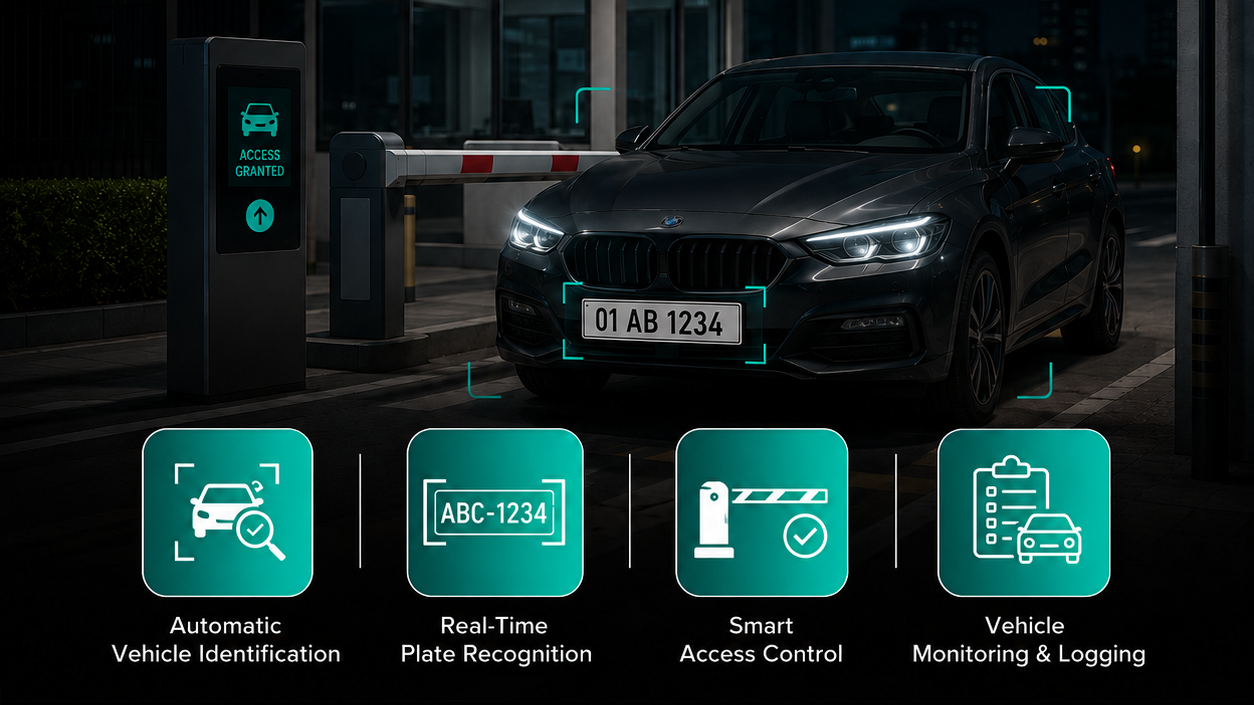
TEKPark is the smart parking product from Tektronix Technology Systems LLC, a UAE-founded ELV and building automation integrator with a broad portfolio spanning security, IoT and low-current systems. The parking offering covers ANPR-based ticketless access, parking guidance and find-my-car, permit management, a mobile app, vehicle gates and barriers, and smart-city parking applications. The positioning is hardware-agnostic, and the company states that TEKPark can work with existing cameras, which is exactly the right posture for the UAE retrofit market. Published performance claims include roughly 99 percent recognition accuracy with sub-two-second passage times using IR-capable ANPR, and the hardware side of the business supplies boom barriers, sliding and swing gates, bollards and road blockers, loop detectors and photo beams.
The genuine strength here is breadth. Because Tektronix operates across the full ELV stack, a customer can place parking, access control, CCTV, intercom and automation with a single contractor and get one AMC covering everything. For a developer building out a tower or a compound where parking is one line item among fifteen, that consolidation has real value, and it removes the interface risk that comes from splitting scope between an ELV contractor and a specialist parking vendor. The company also operates well beyond the UAE, with a presence in Saudi Arabia, Qatar, Kuwait, Oman, Bahrain, Egypt, the UK and the USA, which helps for portfolio owners with regional assets.
The concern is depth on parking specifically. Public material is feature-led, and no parking-specific named case study appeared in the material reviewed. The wider client roster includes names like ADIC, Aldar and DP World, but those should not be read as confirmed TEKPark parking deployments, and any buyer should ask for references that match their exact scope rather than accepting a corporate client list. Camera and barrier models are undisclosed, the payment side is described in general terms without a detailed acquirer or integration list, and the accuracy claims are unverified. Parking is a specialist discipline where tariff logic, revenue reconciliation, offline behaviour and plate accuracy on GCC formats separate a working system from a frustrating one. When parking is one product inside a very large ELV catalogue, it is fair to ask how much dedicated engineering sits behind it. TEKPark is worth shortlisting when you are buying a full ELV package. It is harder to justify when parking is the whole project.
Pros
- Broad ELV and automation capability allowing consolidated scope under one contractor
- Hardware-agnostic positioning with stated support for existing cameras
- Full physical range including barriers, gates, bollards, road blockers and detection
- Single AMC covering parking alongside other building systems
- Presence across the GCC plus the UK and USA
- Useful for developers who want to minimise the number of contractors on site
Cons
- No parking-specific named case studies found in public material
- Corporate client roster should not be assumed to represent parking deployments
- Camera, barrier and ANPR engine models are undisclosed
- Accuracy and passage-time figures are unverified vendor claims
- Payment integrations described only in general terms
- Parking is one of many products, which raises questions about dedicated development depth
8. DESIGNA
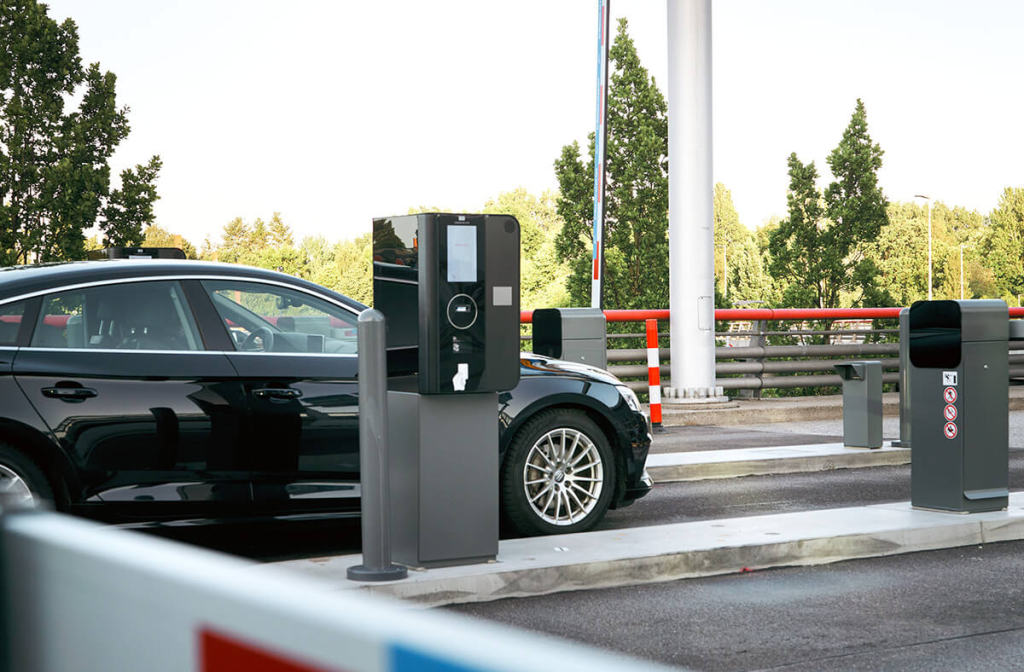
DESIGNA is a long-established German parking OEM, and in the UAE it reaches the market through KTC International Co. LLC, which has operated in the country since 1996 and describes itself as the sole agent for DESIGNA in the region. This is a classic OEM-plus-channel structure. DESIGNA builds the lane equipment, entry and exit terminals, pay stations and core parking management software, and KTC designs, supplies, installs, commissions and maintains the local solution. The combined offering covers ticketed and ticketless parking management, on-street systems, parking guidance, access and security, mechanical parking and wider intelligent transport applications, with ANPR, QR, RFID and card credentials, automatic pay stations, cashier positions and validation.
The reference list is one of the strongest in the country and covers exactly the kind of landmark assets that make procurement committees comfortable. DESIGNA equipment through KTC has been deployed at the Museum of the Future, Mall of the Emirates, Dubai Hills Mall, BurJuman, DIFC, DAFZA, Cityland Mall, RTA and Dubai Municipality car parks, and the Dubai Government Workshop parking guidance system. Zone Parking Solutions also documented a DESIGNA Abacus deployment at JBR The Walk. KTC has associated operations in Qatar, Bahrain, Oman, Kuwait and Saudi Arabia, so regional portfolio owners can maintain consistency across markets. For a large multi-storey car park with heavy throughput, sophisticated tariff structures and a requirement for equipment that has been proven over decades, this is serious, dependable infrastructure.
The trade-offs are the ones that come with every imported OEM model. The software roadmap belongs to the principal in Germany, not to a team in Dubai, so meaningful customisation is either slow, expensive or simply unavailable. If your requirement is a bespoke tenant validation rule, a specific integration with your building management platform or a custom approval workflow, you are asking a European product organisation to accommodate a single UAE site. Capital cost is at the higher end, and the commercial model tends to assume DESIGNA lane hardware throughout, which limits the appeal on retrofits where you want to keep existing barriers and cameras. Buyers should also confirm carefully whether each proposed subsystem is actually DESIGNA or another KTC partner product, since a turnkey ELV scope can quietly mix brands, and should clarify the exact regional scope of the sole-agency rights and the support and spares SLA that comes with it.
Pros
- Mature, proven German engineering with decades of deployment history
- Outstanding UAE reference list including landmark malls, DIFC and government facilities
- Established local channel present in the UAE since 1996
- Full turnkey capability covering design, supply, installation, commissioning and maintenance
- Regional coverage through associated operations across the GCC
- Strong fit for high-throughput multi-storey car parks with complex tariff requirements
Cons
- Software roadmap controlled by the overseas principal, which limits customisation
- Higher capital cost than local software-first alternatives
- Commercial model generally assumes DESIGNA lane hardware, weakening the retrofit case
- Change requests must travel through the channel to the OEM, extending timelines
- Buyers must verify which subsystems are genuinely DESIGNA versus other partner products
- Camera OEM and model often not disclosed and varies by project
9. SKIDATA
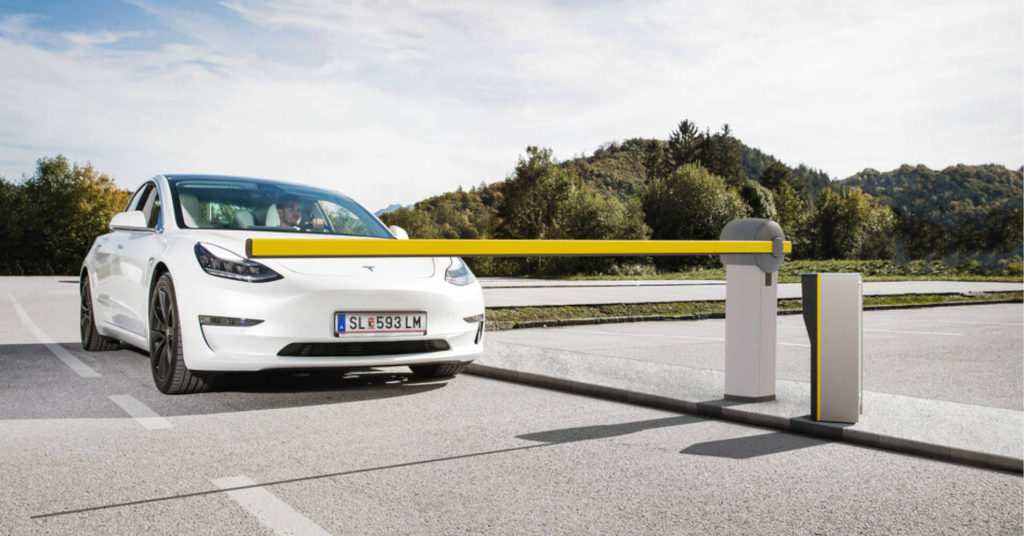
SKIDATA is an Austrian parking and access OEM with a strong global installed base, and in the UAE it is supplied through Al Falak Middle East LLC, a Dubai integrator founded in 1991 that acts as the authorised GCC distributor. As with DESIGNA, you are buying an established international platform delivered by a local ELV and security house. The scope covers off-street parking management, access and visitor control, ANPR, parking guidance, airport and mall parking, and high-security bollards, delivered as turnkey integration with maintenance and support. SKIDATA supplies the barriers, lane equipment and pay-on-foot, cashier, card and validation options, while Al Falak handles design, installation, commissioning and the surrounding security and ELV scope.
The project history is heavyweight and skews toward transport infrastructure, which is where SKIDATA is genuinely excellent. UAE deployments include Abu Dhabi International Airport Terminals 1 to 3, Dubai International Terminal 1 Car Park A, Dubai World Central, RTA car parks at Ghubaiba, Sabkha, Naif and Rigga, parking guidance at Dubai Mall and work at Dubai Sports City, with further projects in Oman. ANPR on the named airport projects used PIPS and CitySync cameras, which is unusually specific disclosure and helpful for technical evaluation. Al Falak has also publicly reported a historical Deira Waterfront contract value of AED 2.3 million, which gives a rough sense of scale for a large multi-lane project, though it is not a reusable unit price. If you operate an airport, a transport hub or a very large mall car park and you need equipment that will run for fifteen years with a global spares chain behind it, SKIDATA belongs on your shortlist.
The caveats are the same family of issues that affect any imported platform, with one addition. Several of the flagship projects are of older vintage, so a current evaluation should not assume the latest generation of hardware or software is what was installed. Customisation is constrained by the principal’s roadmap, capital and licensing costs sit at the premium end, and the model works best when SKIDATA lane hardware is used throughout, which makes it an awkward fit for a retrofit where the goal is to keep existing cameras and barriers and simply add intelligence. Any buyer should require a current SKIDATA authorisation letter, a documented local spares SLA, and the exact ANPR and barrier models proposed for their project rather than relying on the reputation of installations completed years ago.
Pros
- Globally proven platform with a deep installed base and long equipment lifecycle
- Exceptional airport and transport hub track record in the UAE
- Local distributor established since 1991 with full ELV and security capability
- Unusually specific ANPR disclosure on named projects using PIPS and CitySync
- Turnkey delivery covering integration, maintenance and support
- Additional high-security bollard and perimeter capability
Cons
- Several flagship references are of older vintage and may not reflect current technology
- Customisation limited by the overseas principal’s product roadmap
- Premium capital and licensing cost
- Best value assumes SKIDATA lane hardware throughout, limiting retrofit appeal
- Requires verification of current authorisation, spares SLA and proposed models
- Slower response cycle on software changes than a locally owned platform
10. Secure Parking
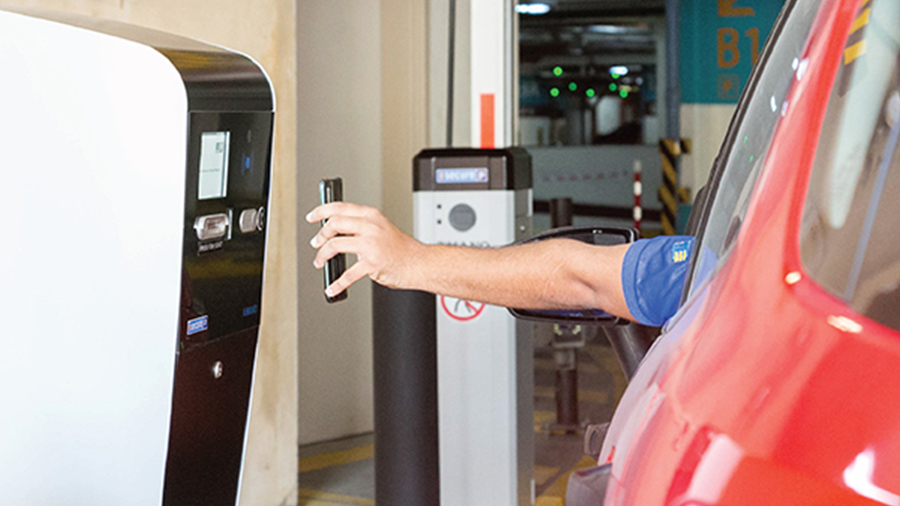
Secure Parking UAE, a member of the Al Shirawi Group, is an unusual hybrid on this list. It is a global parking operator with Australian origins that has been active in the UAE since 2005, and at the same time it is the exclusive UAE distributor and integrator for Amano and Portier. That means Secure Parking can arrive as an operator who takes over your car park, as a technology supplier who sells you Amano Xparc and Xoffice parking management software with Portier guidance, or as a consultant who designs the operation and hands it back to you. Very few companies in the region can genuinely offer all three, and the global network behind it runs more than 1.2 million parking spaces across thirteen countries.
The technical stack is solid and well documented. Amano XGate barriers cover 2.5 to 5 metre arms, run on 24V DC with IP54 protection and loop detection, while Portier Park Vision provides camera-based guidance with integrated ANPR. Payments cover credit cards, QR, automatic pay stations, mobile apps and validation, with open and third-party interfaces available. The UAE portfolio is impressive and destination-heavy, including City Walk, Souk Madinat Jumeirah, Al Seef, The Beach at JBR, DIFC, ADGM, Abu Dhabi World Trade Centre and Uptown Mirdif. The most significant recent development is the April 2026 strategic partnership with Parkin, which brings Parkin app and wallet payments to Secure Parking sites, started with a fully integrated barrierless deployment at City Walk, identified a pipeline of more than 60,000 UAE spaces for barrierless conversion, and extends into Parkin-branded valet locations managed by Secure Parking.
The complexity is also the catch. When one company is your operator, your technology supplier and your consultant, the commercial interests are layered, and it takes a disciplined buyer to keep them separate. Compare the Amano and Portier equipment scope on its own merits, then evaluate Secure Parking’s operating fee separately, and treat the Parkin-enabled barrierless offer as a third distinct decision. Otherwise it becomes very difficult to tell whether you are paying a fair price for the technology or subsidising an operating model. The Amano platform itself carries the standard imported-OEM limitations around deep customisation, and the Parkin partnership, while commercially powerful, pulls your driver experience toward the Parkin ecosystem rather than your own brand. For destination retail and hospitality assets where you want proven operations and are comfortable with an ecosystem relationship, Secure Parking is a strong contender. For owners who want to retain full control of technology, data and brand, the structure works against you.
Pros
- Rare combination of operator, technology distributor and consultant in one organisation
- Global network of more than 1.2 million spaces across thirteen countries
- Well-documented Amano hardware with clear specifications
- Portier camera-based guidance with integrated ANPR
- Excellent destination retail and hospitality references across Dubai and Abu Dhabi
- Parkin partnership unlocks barrierless capability and app-based payment at scale
- Local group backing through Al Shirawi reduces counterparty risk
Cons
- Layered commercial interests make it hard to isolate a fair technology price
- Operating model often bundled with the technology proposition
- Amano platform customisation constrained by the overseas principal
- Parkin partnership pushes the driver experience into an external ecosystem
- Less suitable for corporate, healthcare, industrial and residential sites
- Requires a disciplined procurement process to separate the three offers
11. VIGILANTE PMS
VIGILANTE PMS, also referred to as VGS, is the parking and access platform from SSK Technologies LLC, part of the SSK Group, an established regional security technology integrator based in Dubai. SSK’s core expertise is ANPR, and it shows in the company’s positioning. Rather than being a general parking vendor that added plate recognition, SSK is a recognition specialist that built a parking layer on top. The company is a development partner and channel for Adaptive Recognition, one of the strongest ANPR technology houses in the world, and publicly associated hardware and software includes Adaptive Recognition Carmen and FreeFlow, FreewayCAM, VIDAR and Einar Smart Gen2 8MP cameras. The VIGILANTE and VGS software layer handles ticketless parking, hotel and access control applications, guidance, permits, tenant and employee parking, and enforcement and traffic applications through a central VGS platform.
The credentials on recognition accuracy are exceptional. SSK’s portfolio includes ANPR and access control work associated with Burj Khalifa and Burj Al Arab, Dubai Police OYOON, Expo 2020, Sharjah RTA toll systems, and references at Dubai Airport and Dubai Mall, with the company claiming more than 400 locations across the UAE and GCC. If your project genuinely lives or dies on plate reading performance, for example a high-security facility, a toll-adjacent application, a police or government site, or a barrierless car park where every missed read is lost revenue, SSK’s technology base is arguably the most serious on this list. Integration with access control, ground and overhead sensors, and security and police platforms is well established.
The gap is on the commercial parking side rather than the technology side. SSK is a security and traffic business first, and the parking-specific references are harder to separate from the wider security and enforcement portfolio, which means a buyer should explicitly ask for parking projects that match their scope rather than accepting the corporate portfolio at face value. Payment methods are not consistently published, which is a meaningful gap for any revenue parking application where you need QR, wallet, card and cash handling with proper reconciliation. Barrier OEMs are generally not disclosed, and the customer-facing side of parking, meaning tenant portals, booking flows, validation logic, mobile apps and self-service, receives far less attention in public material than the recognition engine does. Buyers should also confirm which generation of Adaptive Recognition hardware is being proposed and who carries support responsibility, since being a channel partner means part of the escalation path sits with the principal.
Pros
- Outstanding ANPR pedigree through the Adaptive Recognition partnership
- Named camera and recognition software rather than undisclosed generic hardware
- High-security and government credentials including Dubai Police OYOON and Expo 2020
- Claimed presence at more than 400 locations across the UAE and GCC
- Strong integration with access control, sensors and security platforms
- The right answer when recognition accuracy is the primary risk on the project
Cons
- Parking-specific references are hard to separate from wider security and traffic work
- Payment methods and revenue reconciliation capability are not consistently published
- Barrier OEMs generally not disclosed
- Driver-facing experience, booking and validation receive less development focus
- Support escalation partly depends on the overseas technology principal
- Camera generation varies between projects and needs to be confirmed per bid
12. PARCX
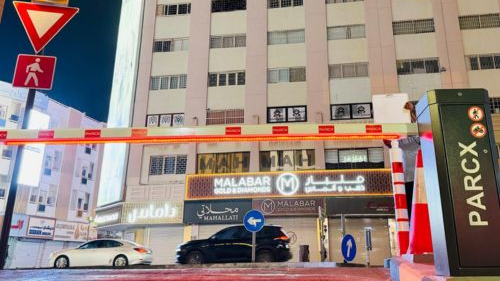
PARCX Technology LLC is a Dubai-based parking technology OEM with products described as made in the UAE, and it is one of the more interesting propositions on this list because it is genuinely modular by design. The product family includes PARKPAY for payments, PAXESS for access, Lane Intelligence for entry and exit control and Digiview for visualisation, and the architecture is explicitly built to work with third-party hardware rather than locking the customer into a single equipment family. Capability covers revenue and non-revenue parking, pay-by-plate, cloud SaaS deployment, logistics and reservation workflows, and access control, with detection through ANPR, laser and loop, UHF and RFID.
The integration story is the strongest part of the pitch, and it is broader than most competitors here. PARCX documents integration with CRM, ERP, BI and MIS platforms, building management systems and visitor systems, along with mobile booking and payment, open APIs, third-party hardware and RFID, UHF and QR credentials. Payment support is comprehensive, covering coins, banknotes, cards, e-wallets, tap and go, pay stations, cashier and handheld operation, and validation. The reference that stands out is DNATA Cargo Village, a fifteen-lane deployment with logistics CRM and reservation functionality handling a stated volume of around 8,000 vehicles a day. That is a demanding, high-throughput logistics environment, and delivering it successfully says more about the platform than a list of mall names would. Other projects include Deira Waterfront plots, Metropolis Tower, Venetian in Dubai Sports City, and Salalah Gardens Mall in Oman.
The limitations are mostly about scale and evidence rather than capability. PARCX is a smaller organisation than the international OEMs, so buyers should confirm implementation bandwidth, support coverage and escalation depth for large or multi-site rollouts. Exact camera brands are not disclosed and barrier models are not named, so the specific bill of materials needs to be pinned down per project. For anyone considering the cloud SaaS option, data residency arrangements and cybersecurity evidence should be requested in writing, particularly for government-adjacent or regulated sites. The public reference base, while high quality, is narrower than the market leaders. For logistics facilities, cargo operations, industrial sites and any project where the parking system must exchange data with enterprise platforms, PARCX is a genuinely capable and often underrated option.
Pros
- Modular architecture designed from the start for third-party hardware
- Excellent enterprise integration coverage including CRM, ERP, BI and BMS
- Comprehensive payment support from coins and notes through to e-wallets and handhelds
- Proven high-throughput logistics deployment at DNATA Cargo Village
- Cloud SaaS option alongside conventional deployment
- UAE-based product development with local accountability
- Handles both revenue and non-revenue parking scenarios cleanly
Cons
- Smaller organisation, so delivery bandwidth for large multi-site rollouts needs verification
- Camera and barrier OEMs are not disclosed
- Narrower public reference base than the market leaders
- Data residency and cybersecurity documentation must be requested rather than published
- Support SLA depth should be confirmed before contracting
- Less brand recognition with procurement committees than the international names
13. Zone Parking Solutions
Zone Parking Solutions, operating alongside Parking District Solutions, is a UAE parking operator, consultant and technology integrator with roots reported back to a 2008 joint venture and heritage that includes UK parking expertise. The company positions itself across the full lifecycle, offering consultancy, design, implementation, operation and maintenance, which makes it as much an advisory business as a technology one. Capability covers on-street and off-street parking, central parking management systems, ANPR, parking guidance, pay-by-phone, pre-booking and an enforcement and command centre operation. Integrations include telecom and SMS billing, mobile apps, virtual wallets, pay and display and pay-on-foot equipment, bay sensors, retail validation and a central data and command centre.
The reference list is notable for the calibre of the locations rather than the volume. Zone has documented work at JBR The Walk covering 550 bays using DESIGNA Abacus equipment, at DIFC Gate and Gate Village, consultancy on Dubai Mall, and Central Market Souk. The DESIGNA deployment is a useful signal, because it shows Zone operates as a genuine integrator that selects and deploys established third-party equipment rather than pushing a single proprietary box. For an owner who does not yet know what they need, particularly someone at the feasibility stage of a large mixed-use development trying to work out demand, tariff strategy, bay allocation and enforcement policy before selecting technology, the consulting capability has real value that pure product vendors cannot match.
The concerns are around currency and transparency. Several of the publicly documented projects and technology descriptions date back some years, ANPR accuracy is described as exceeding 85 percent on Middle Eastern plates, which was respectable when published but sits well below what modern engines deliver on GCC formats today, and current barrier OEMs and camera models are not disclosed. Much of the technical detail is first-party, and the current legal and channel structure of the business should be confirmed during prequalification. Because Zone also operates car parks, the same conflict of interest question applies as with any operator-consultant hybrid, and buyers should be clear about whether they are engaging Zone for independent advice or for an operating relationship. If you need strategy and design, Zone is worth a conversation. If you need a modern, deeply integrated technology platform with current performance, the software-first players on this list are a better match.
Pros
- Genuine consultancy capability covering feasibility, demand modelling and tariff strategy
- Full lifecycle offering from design through to operation and maintenance
- Vendor-neutral integrator approach with documented DESIGNA deployment
- Prestigious references including JBR The Walk, DIFC and Dubai Mall consultancy
- Command centre and enforcement operations capability
- UK parking heritage brings mature operational methodology
Cons
- Several published projects and technical descriptions are dated
- Published ANPR accuracy figures are well below current market standards
- Current barrier and camera OEMs are undisclosed
- Most technical claims are first-party and unverified
- Operator and consultant roles in one business create a potential conflict of interest
- Legal and channel structure should be confirmed during prequalification
The Verdict After Comparing All Thirteen
The following is the honest summary of what this comparison shows.
If you operate public on-street parking in Dubai or Abu Dhabi, the decision is made for you. Parkin and Q Mobility hold the mandates, and your job is to integrate with them cleanly rather than compete.
If you own a destination retail or leisure asset and you want parking to become somebody else’s problem, Parkonic and Secure Parking are the strongest operator options, with Parkonic ahead on barrierless coverage and Salik integration, and Secure Parking ahead on operational maturity and its Parkin partnership. You will trade control and revenue share for convenience.
If you are building a large new multi-storey car park with heavy throughput and a fifteen-year equipment horizon, DESIGNA through KTC and SKIDATA through Al Falak are the safest engineering choices, with CASS as the strongest local manufacturing alternative and a meaningful cost advantage.
If plate recognition accuracy is the single biggest risk on your project, SSK’s VIGILANTE platform has the deepest technology behind it.
If your parking system needs to exchange data with enterprise platforms in a logistics or industrial environment, PARCX deserves a serious look.
And if what you actually need is a system shaped around your operation, working with the hardware you already own, delivered and supported by a team on the ground in the UAE under a single contract, that is where Entry2Exit sits at the top of this list. It is first because for the majority of private UAE sites, the combination of brand-agnostic integration, genuine end-to-end delivery, full payment coverage and real customisation removes more cost and more risk than any other option in this comparison.
Other Parking Management Systems and Operators Worth Knowing
The thirteen above are the ones most UAE buyers will realistically shortlist, but they are not the whole market. Here are the other names you are likely to encounter during procurement, each with the one thing you need to know about them.
- GreenParking (Future Link LLC) is a Dubai operator and supplier covering parking management, guidance, valet, EV charging and robotic parking, with projects including Business Central Towers, Marina Gate, Dubai Healthcare City, Dubai Opera and Emirates Towers, and a claimed 600-plus EV chargers across the GCC.
- Mawgif (National Parking Company) is a Saudi-headquartered airport and municipal parking operator active in the UAE since 2015, best known for a ten-year DXB and DWC parking concession and Scan, Pay and Go at Dubai Airports.
- Leadtek Security Solutions is an Abu Dhabi ELV integrator delivering ticketless parking, ANPR and barriers, with documented projects at Al Maryah Tower, Baniyas Towers and Reem Nine using BFT barriers.
- Sion General Trading is an SME-focused Dubai reseller and installer working mainly with ZKTeco and similar equipment, and one of the very few vendors publishing indicative price ranges, from roughly AED 3,000 for a barrier only up to AED 80,000 or more for a full ANPR system.
- EZPARK UAE is an emerging Dubai smart-parking integrator marketing ANPR, barrier automation and cloud parking management, though its legal entity, OEM relationships and completed projects are not clearly disclosed publicly.
- Concordia (ParkAssist) is a DMCC-linked facilities manager that operates community parking and bay leasing across most of Jumeirah Lakes Towers and Business Bay, relevant as an operator rather than as a technology vendor.
- Salik is Dubai’s listed toll operator and functions as a payment and vehicle-identity rail rather than a parking system, integrated into partner platforms including Parkonic, Dubai Holding sites and Dubai Airports parking.
- Amano is the Japanese parking OEM behind Xparc and Xoffice, reaching the UAE through Secure Parking as exclusive distributor.
- Adaptive Recognition is a Hungarian ANPR technology house whose Carmen engine and camera range sit inside several UAE parking and enforcement systems, usually through local partners rather than direct.
- Nedap supplies long-range vehicle identification and UHF reader technology used in resident and staff parking lanes across the region, typically as a component within a larger system.
- Scheidt & Bachmann, HUB Parking Technology and Flowbird are international parking OEMs that appear periodically in UAE tenders through regional channels, mostly on large infrastructure and municipal projects.
- ZKTeco supplies barriers, readers and entry-level parking equipment widely resold across the UAE SME market, generally through trading and installation companies rather than direct.
A word of caution on this list. Several of these companies are excellent at what they do, but very few of them are complete parking management systems. Some are operators, some are payment rails and some are component suppliers. Confirm which category a vendor sits in before you put them on the same evaluation sheet as a full platform.
How to Choose the Right Parking Management System
Most parking procurement goes wrong at the beginning, not at the end. The buyer starts by collecting quotations, which means they end up comparing prices for four fundamentally different things and picking whichever number looks smallest. Work through the following decision paths in order instead, and the shortlist will build itself.
Decision Path 1: What is your parking actually for?
Start here, because the answer changes everything downstream.
If parking is a revenue business and you charge the public to park, you need tariff flexibility, validation logic for tenants, robust payment options, revenue reconciliation your finance team trusts, and enforcement or barrierless recovery for non-payment. Prioritise vendors with a strong payment stack and proven revenue reporting. Operators like Parkonic and Secure Parking, and platforms like Entry2Exit, PARCX and CASS, all fit here.
If parking is an access control function at a corporate campus, hospital, school, industrial site or residential tower, revenue matters less and identity matters more. You need clean integration with visitor management, HR or tenant databases, access control readers and security systems, plus approval workflows and permit management. Prioritise integration depth over payment sophistication. Entry2Exit, Parkomax and SSK are the natural fits.
If parking is a customer experience differentiator at a hotel, luxury retail or premium residential asset, the driver-facing experience is the product. You need branded receipts and payment screens, valet workflows, guest invitations, guidance that reduces search time, and an app that carries your name rather than a vendor’s. Customisation capability becomes the deciding criterion.
If parking is a compliance or capacity problem and you simply need to stop unauthorised vehicles and understand occupancy, a lighter deployment will do. Do not over-buy. A barrier, ANPR and a basic management layer may be all you need.
Decision Path 2: What is already installed on your site?
If you have nothing, a greenfield site, you have full freedom. Either you can go with a full fledged system like Entry2Exit or Compare total system cost including hardware, and weigh manufacturer-led options like CASS or established OEMs like DESIGNA and SKIDATA against software-first platforms that will procure hardware for you.
If you have working cameras and barriers, this is the most common and most expensive mistake in the market. Many vendors will quote you a full replacement because their system only really works with their own equipment. Insist on brand-agnostic platforms that can sit on top of your existing Dahua, Hikvision, ISS, Nice, Came or BFT hardware. This is where Entry2Exit, PARCX and TEKPark should be on your list and where the imported OEM model works against you.
If you have partial infrastructure, for example cameras but no barriers, or barriers but no ANPR, map exactly what stays and what goes before you invite quotations, and make every vendor price against the same defined scope. Otherwise the comparison is meaningless.
If you have an existing system that has failed you, diagnose why before replacing. If the problem was plate recognition accuracy, the camera and engine are the issue. If it was support response, the vendor relationship is the issue. If it was inflexibility, the platform architecture is the issue. Replacing an inflexible imported system with a different inflexible imported system solves nothing.
Decision Path 3: Who will run it day to day?
If you have an in-house facilities or security team, buy a system and keep control. You want training, documentation, admin access and a clear support escalation path.
If you have no team and no appetite to build one, an operator model makes sense. Parkonic, Secure Parking, GreenParking or Concordia will run the asset for you, and you accept reduced control and a revenue share in exchange.
If you have a team but no parking expertise, a fully managed deployment with strong local training and support is the middle path. This is precisely the gap that end-to-end providers with on-ground UAE staff are built to fill.
Decision Path 4: How many sites, and what comes next?
Single site with no expansion plans: optimise for cost and simplicity.
Multiple sites today: multi-location management with global and local admin roles becomes non-negotiable. Ask to see a live cross-site dashboard, not a slide.
Single site with expansion planned: buy the multi-site architecture now. Migrating three years of parking data and retraining staff on a second platform costs far more than the price difference at signing.
Portfolio across emirates or countries: confirm the vendor can support different tariff regimes, languages, currencies and regulatory requirements in one platform, and check their support footprint in each market.
The Final Parking Management System Checklist
Take this into every vendor meeting. If a supplier cannot answer these clearly and in writing, that is your answer.
Technology
- Does the system work with our existing cameras and barriers, named by brand and model?
- What ANPR engine is used, and what is its measured accuracy on UAE and GCC plate formats specifically?
- How does the system behave when the internet connection drops? Does the barrier still open?
- Is deployment available on-premise, on our own cloud, and on a managed cloud?
- Can it run gated, barrierless and hybrid modes as our site evolves?
- What happens when a plate is misread at exit? What is the recovery workflow?
Payments
- Which payment methods are supported: QR, Apple Pay, Google Pay, Samsung Wallet, tap and go, cards, cash?
- Can staff take payment at the vehicle with a handheld device and print a receipt?
- Does it integrate with Salik, Darb or Nol where relevant to our site?
- How is revenue reconciled, and can finance export directly into our accounting system?
- Who owns the merchant relationship and where does the money actually settle?
Integration
- Which access control platforms are already integrated, named specifically?
- Can it connect to our visitor management, building management or tenant portal?
- Is there a documented API, and can we see the documentation before signing?
- Does it support EV charger integration if we need it now or later?
Customisation
- Can tariff rules, validation logic and approval workflows be changed to match our policy?
- Can the interface and receipts carry our branding?
- Is a customised mobile app available, or only a generic vendor app?
- Who makes changes, how long do they take, and what do they cost?
Delivery and support
- Who does the physical installation, cabling and commissioning?
- Is the support team based in the UAE, and what are the response times in writing?
- Is training included, and for how many staff?
- What does the AMC cover, what does it exclude, and what does it cost annually?
- Is remote support available, or does every issue require a site visit?
Commercial and legal
- Is this a purchase, a subscription or a revenue share?
- Who owns the parking data generated by our site?
- What happens to our data and hardware if we terminate?
- Are there per-transaction or per-space recurring fees beyond the licence?
- Can we see three reference sites of comparable size and type?
Third-Party Integrations You Should Consider
A parking system that cannot talk to anything else creates a data island, and data islands get replaced within five years. These are the integration categories worth planning for, whether or not you need them on day one.
ANPR cameras and detection. Dahua, Hikvision, ISS, Hanwha, SSK, Adaptive Recognition, Axis and PIPS all appear in UAE parking projects. Confirm which specific models your vendor has actually deployed, not which ones they say are compatible.
Barriers and lane hardware. Came, BFT, Nice, FAAC, Amano, DESIGNA, SKIDATA and CASS are the brands you will meet. If you already own barriers, this is the integration that saves the most money.
Access control. Suprema, Genetec, HID, Paxton and ZKTeco readers are common across UAE buildings. If your parking system and your building access system maintain separate user databases, your security team will be doing double data entry forever.
Payment and wallets. Apple Pay, Google Pay, Samsung Wallet, tap and go contactless cards, QR wallets, card acquirers, and vehicle-linked accounts including Salik, Darb and Nol. Coverage here directly determines exit lane throughput.
Enterprise systems. Oracle, Microsoft 365 and Azure, Salesforce, Zoho and other CRM, ERP and BI platforms. Finance teams want parking revenue in the same reporting environment as everything else.
Building and facility systems. Building management systems, visitor management, hot desking, meeting room booking and facility and asset management. Parking is usually the first touchpoint of a visitor journey, so connecting it to visitor management removes an entire manual step at reception.
Directory and identity. Active Directory and LDAP for staff parking entitlements, so leavers lose parking access automatically when HR deactivates them.
Guidance and displays. Bay-level LED indicators, direction arrows, occupancy displays, car-finder kiosks and audio guidance. These reduce search time, which is the single biggest driver of parking frustration.
EV charging. Charge point operators and networks, with unified billing so a driver books, parks and charges in one flow rather than juggling two systems.
Communication. SMS gateways, WhatsApp, email and push notifications for invitations, payment confirmations, grace period reminders and violation alerts.
Enforcement and municipal platforms. Where a site interacts with public parking regimes or police systems, integration requirements will be dictated externally and need to be confirmed early.
Quick Parking Management System Comparison Table
| Brand | Type | UAE based | Works with existing hardware | Barrierless capable | Payment methods | On-ground UAE support | Dashboard and analytics | Customisation depth |
|---|---|---|---|---|---|---|---|---|
| Entry2Exit | Software platform and hardware solutioning | Yes | Yes, brand agnostic by design | Yes, gated, barrierless or hybrid | QR, Apple Pay, Google Pay, Samsung Wallet, tap and go, cards, cash via handheld POS with receipts | Yes, own installation, training and support staff | Yes, custom dashboards, occupancy, revenue, forecasts, live notifications | Full, workflows, UI, logic and app customised per client |
| Parkin | Public concession operator | Yes | Not applicable, operator model | Yes, live at MAF malls and Al Rigga | App, SMS, WhatsApp, Apple Pay, cards, Nol | Yes, operator field teams | Operator reporting, not a client dashboard | None for the client |
| Parkonic | Private operator with own platform | Yes | Not applicable, operator model | Yes, Free Flow at scale | App wallet, Salik, tap and go, QR, SMS, cards, terminals | Yes, operator field teams | Cloud portal, operator controlled | Limited, operator defined |
| Q Mobility (Mawaqif) | Government mobility operator | Yes | Not applicable, operator model | Yes, Mawaqif Free Flow | Darb auto-debit, QR, web, SMS, meters | Yes, government field teams | Not offered to private clients | None for the client |
| CASS | UAE hardware manufacturer plus software | Yes | Partial, designed around own equipment | Yes, ticketless supported | Pay station, notes, cards, wireless, validation, cashier | Yes, local manufacturer support | Central management, standard reporting | Moderate, within own product family |
| Parkomax | Software platform and integrator | Yes | Partial, named integrations with Axis and Paxton | Yes, ticketless supported | Auto-pay, tap and go, QR, cards, validation | Yes, direct and via integrator channel | Multi-site dashboard | Moderate, configuration led |
| TEKPark | ELV integrator with parking product | Yes | Yes, stated support for existing cameras | Yes, ANPR ticketless | App and wallet integrations, detail not published | Yes, full ELV field capability | Analytics included, depth not published | Moderate, integrator led |
| DESIGNA (KTC) | International OEM via local channel | Channel is UAE, OEM is German | Limited, assumes DESIGNA lane hardware | Partial, depends on generation | Pay stations, cashier, cards, QR, validation | Yes, KTC since 1996 | OEM standard reporting | Low, controlled by principal |
| SKIDATA (Al Falak) | International OEM via local channel | Channel is UAE, OEM is Austrian | Limited, assumes SKIDATA lane hardware | Partial, depends on generation | Pay on foot, cashier, cards, validation | Yes, Al Falak since 1991 | OEM standard reporting | Low, controlled by principal |
| Secure Parking | Operator plus Amano and Portier distributor | Yes, Al Shirawi Group | Partial, Amano centric | Yes, via Parkin partnership | Cards, QR, pay stations, apps, validation, Parkin wallet | Yes, operator and integrator teams | Operator reporting plus Amano Xoffice | Low to moderate, OEM constrained |
| VIGILANTE (SSK) | ANPR specialist and integrator | Yes | Yes, integration led | Yes, FreeFlow capable | Not consistently published | Yes, established local integrator | Central VGS platform | Moderate, strong on recognition logic |
| PARCX | UAE technology OEM, modular | Yes | Yes, designed for third-party hardware | Yes, pay by plate supported | Coins, notes, cards, e-wallet, tap and go, pay stations, handheld, validation | Yes, UAE based team | Digiview visualisation and reporting | High, modular architecture |
| Zone Parking | Operator, consultant and integrator | Yes | Yes, vendor neutral integrator | Partial, depends on deployment | Pay by phone, SMS, app wallet, meters, pay on foot | Yes, operations and command centre | Central data and command centre | Moderate, project specific |
How a Parking Management System Actually Works
Most vendor material skips this, which is why so many buyers approve a design they do not fully understand. Here is the complete process, from a vehicle approaching the entrance to money landing in your account.
Step 1: Approach and detection. A vehicle approaches the entry lane. A ground loop, radar or photo beam detects its presence and triggers the entry sequence. This is the trigger layer, and it is why a barrier does not open for a pedestrian or a shadow.
Step 2: Plate capture and recognition. An ANPR camera captures the number plate. The image is processed by the recognition engine, which converts the image into a plate string plus an emirate or country code. This is the single most important technical step in the entire system. GCC plates are difficult, with multiple emirates, mixed Arabic and Latin characters, varied plate layouts and a wide range of formats, which is exactly why a recognition engine tuned for this region outperforms a generic imported one.
Step 3: Identification and rules. The system checks the plate against its databases. Is this a registered resident, a staff member, a subscriber, a pre-registered visitor, a blacklisted vehicle or an unknown? Each category triggers different logic. A resident may enter free. A pre-invited visitor may be granted a defined access window. An unknown vehicle starts a paid session, or is refused if the site does not accept casual parking.
Step 4: Access decision and barrier control. Based on the rules, the system sends a command to the barrier controller, or in a barrierless site simply logs the entry and starts the session. In a well-designed system this happens in under two seconds, which is what stops queues forming at the entrance during peak.
Step 5: Occupancy update and guidance. The system decrements available capacity, updates LED displays at the entrance and inside the facility, and if bay-level guidance is installed, LED indicators and directional arrows guide the driver to a free space. Good guidance can cut in-facility search time dramatically, and search traffic is what makes a busy car park feel worse than it actually is.
Step 6: The parked session. While the vehicle is parked, the system is tracking duration, applying the correct tariff structure including grace periods, free hours, subscriptions and any event pricing, and making occupancy data available on the dashboard in real time. If the driver uses a mobile app, they can see their running charge and pre-pay.
Step 7: Validation. In retail and hospitality environments, a tenant or outlet can validate a driver’s parking based on a purchase or a visit, either at a kiosk, through a tenant portal or via an API from the point-of-sale system. The validation is applied against the open session so the amount payable at exit is already reduced.
Step 8: Payment. This can happen in several ways depending on how the site is configured. The driver pays at a pay station or kiosk before returning to the vehicle. They scan a QR code on signage or on their ticket and pay by phone. They pay a staff member at the vehicle using a handheld POS device and receive a printed receipt. They pay at the exit lane using a contactless card, Apple Pay, Google Pay or Samsung Wallet. Or, in a fully barrierless setup, nothing happens at all and the amount is automatically debited from a linked vehicle account such as Salik or Darb.
Step 9: Exit and reconciliation. At the exit lane the plate is read again, the session is matched, payment status is confirmed and the barrier opens, or in a barrierless site the session simply closes. If payment has not been made, the system applies the site’s recovery policy, whether that is a grace period, a follow-up notification or a violation record.
Step 10: Reporting and settlement. Every transaction flows into the reporting layer. Occupancy trends, revenue by hour and by tariff class, average dwell time, peak utilisation, validation cost by tenant and exception reports all become available. Payment settles through the merchant relationship into your account, and finance reconciles against the system’s transaction log, ideally exported straight into the accounting platform.
The layer underneath all of this. None of the above works without the physical groundwork. Power and network provisioning to every lane, correctly specified trenching and cabling, camera mounting at the right height and angle for reliable plate capture, loop installation cut into the road surface, barrier foundations, signage placement so drivers understand the rules before they commit to the lane, and multiple rounds of on-site testing under real conditions. This is the layer buyers underestimate most often, and it is the layer where a supplier without on-ground capability quietly becomes your problem.
Head to Head: Entry2Exit vs Every Other System on This List
Category-level comparison only takes you so far. Here is the direct read on each pairing, including the situations where the other provider is the better answer.
Entry2Exit vs Parkin
Entry2Exit is the right choice for any private facility, because it is the only option here that leaves you owning the operation. Parkin holds the Dubai public parking concession and operates roughly 268,300 spaces, and in its developer segment it now manages more than 61,500 spaces through partnership agreements. But that model means handing over the operation, putting the driver in the Parkin app, and giving Parkin a commercial position in your revenue. Entry2Exit sells you the system outright. You keep your tariffs, your branding, your data and every dirham of your revenue, and you integrate with visitor management, access control and building systems on your terms. Parkin makes sense only if you want parking to stop being your responsibility and are comfortable inside someone else’s ecosystem. Everywhere else, Entry2Exit wins.
Entry2Exit vs Parkonic
Entry2Exit wins on every axis that matters to an asset owner, because Parkonic is not selling you a platform at all. Parkonic works in an operator model: you outsource the car park, the tariff decisions, the app experience and a slice of the revenue. Entry2Exit sells you the system and stays entirely out of your P&L. It is also far stronger on integration breadth, customisation and the non-revenue use cases that most sites actually run on, including staff, tenant and visitor parking. Parkonic has a narrow fit in high-footfall public destinations chasing monetisation through an existing network. For corporate, healthcare, education, industrial, hospitality and residential sites, and for anywhere parking must connect to the rest of the building, Entry2Exit is the stronger buy.
Read our Parkonic Alternative guide
Entry2Exit vs Q Mobility (Mawaqif)
Entry2Exit is the platform layer you actually buy, and it works with the Abu Dhabi parking ecosystem. Q Mobility governs public parking across Abu Dhabi and runs Mawaqif Free Flow with Darb wallet settlement, which is a regulatory position, not a product you procure for your own facility. Entry2Exit runs the private facility itself: your tariffs, your access rules, your integrations, your reporting, while aligning with Mawaqif tariff logic and supporting Darb settlement where drivers expect it. Q Mobility is unavoidable for public, regulated or on-street parking. For every private facility inside or beside that regime, Entry2Exit is the system that gives you control.
Entry2Exit vs CASS
Entry2Exit wins on software depth, retrofit flexibility and value, which is where most UAE projects are actually decided. CASS is a credible local competitor with published model numbers, in-country spares and reference sites including Cleveland Clinic Abu Dhabi and Dubai Creek Harbour. But CASS is a hardware company first. On a site with existing barriers, cameras or controllers, CASS asks you to migrate toward its own product family, while Entry2Exit sits on top of what you already own and protects that investment. On the software side the gap is wider still: approval workflows, tenant portals, visitor invitations, custom mobile apps and payment breadth are all Entry2Exit strengths that CASS does not match. CASS suits a hardware-led greenfield build with budget to spare. For retrofits, mixed-brand estates and any project where the software carries the operation, Entry2Exit is the better system at a better price.
Entry2Exit vs Parkomax
Entry2Exit is the stronger platform of the two UAE software players, mainly on ecosystem breadth and delivery accountability. Parkomax has credible public sector references including Dubai Courts and Traffic Police, and documented integrations with Axis and Paxton. That list is the limitation. Entry2Exit’s integration coverage spans the camera, barrier, access control and enterprise brands that actually dominate UAE sites, not two of them, and payment coverage is broader and better documented. Delivery is the other separator: Entry2Exit installs, cables and commissions with its own on-ground staff under a single accountable contract, rather than routing delivery through third-party integrators. Parkomax fits a site already standardised on Axis and Paxton with an ELV contractor leading the job. For mixed-brand hardware, single-contract accountability and genuine workflow customisation rather than configuration, Entry2Exit wins.
Entry2Exit vs TEKPark
Entry2Exit wins whenever parking is the project rather than a line item. TEKPark’s strength is consolidation: CCTV, access control, intercom, automation and parking under one contractor with one AMC. What you give up is depth. Parking sits inside a very large ELV catalogue, no parking-specific case studies appear in public material, and the camera, barrier and payment specifics are undisclosed. Entry2Exit does one category and does it completely, with published integrations, documented payment methods and named parking deployments you can go and look at. TEKPark is defensible only when parking is a small item inside a large multi-system package. If getting the parking right matters, Entry2Exit is the choice.
Entry2Exit vs DESIGNA
Entry2Exit wins on flexibility, speed of change and cost, and those are usually the deciding factors outside the largest greenfield builds. DESIGNA through KTC is proven German engineering with an outstanding reference list covering the Museum of the Future, Mall of the Emirates, Dubai Hills Mall, BurJuman and DIFC. The constraint is that the software roadmap sits in Germany. A bespoke validation rule, a specific building management integration or a custom approval workflow means asking a European product organisation to accommodate one UAE site, on their timeline, and the commercial model generally assumes DESIGNA lane hardware throughout. Entry2Exit builds those changes locally, works with the hardware already installed, and comes in significantly cheaper on retrofits. DESIGNA earns its premium on very large greenfield multi-storey builds with a fifteen-year hardware horizon. For everything else, Entry2Exit is the better decision.
Entry2Exit vs SKIDATA
Entry2Exit wins outside the airport and transport-hub category, which is the only place SKIDATA’s premium is justified. SKIDATA through Al Falak has an exceptional record covering Abu Dhabi International Terminals 1 to 3, DXB Terminal 1 Car Park A, Dubai World Central and RTA car parks. For everything else, the constraints are real: premium cost, limited customisation, a model that assumes SKIDATA hardware end to end, and several flagship references of older vintage. Entry2Exit delivers modern recognition, broader payment coverage, deeper workflow customisation and hardware-agnostic retrofits at a fraction of the cost. Take SKIDATA for airports and very large infrastructure assets. For commercial, residential, hospitality, healthcare, education and industrial sites, and for any retrofit, Entry2Exit wins.
Entry2Exit vs Secure Parking
Entry2Exit wins on commercial clarity, which is exactly where Secure Parking is weakest. Secure Parking is simultaneously an operator, a technology distributor for Amano and Portier, and a consultant, backed by Al Shirawi and a global network of 1.2 million spaces, and its April 2026 partnership with Parkin adds barrierless capability across a 60,000-space pipeline. Three commercial interests inside one relationship make it very hard to know whether you are buying technology at a fair price or funding an operating model. The driver experience also drifts toward the Parkin app rather than your brand. Entry2Exit sells you a system with one scope, one price and no position in your revenue, and your brand stays on the receipt. Secure Parking suits destination retail and hospitality owners happy to sit inside an ecosystem. If you want to keep control of technology, data, branding and revenue, Entry2Exit is the answer.
Entry2Exit vs VIGILANTE PMS (SSK)
Entry2Exit wins on everything that happens after the plate is read, which is most of what a parking operation actually does. SSK has strong recognition technology through its Adaptive Recognition partnership, with named hardware including FreewayCAM, VIDAR and Einar Smart Gen2 cameras running Carmen, plus credentials on Dubai Police OYOON, Expo 2020 and Burj Khalifa. Recognition alone does not run a car park. Payments, validation, tenant and visitor workflows, booking, guidance, dashboards, the mobile app and revenue reconciliation are all documented far more thoroughly on the Entry2Exit side, and Entry2Exit reads plates accurately on GCC formats too. SSK fits high-security and enforcement-heavy government-adjacent projects where recognition accuracy is the entire risk. For commercial parking operations, Entry2Exit is the complete system.
Entry2Exit vs PARCX
Entry2Exit wins on delivery capability, payment stack and integration breadth, which is what separates two platforms that share a philosophy. PARCX is the most underrated name on this list: modular architecture designed for third-party hardware, broad enterprise integration across CRM, ERP, BI and BMS, and a fifteen-lane DNATA Cargo Village deployment handling around 8,000 vehicles a day. The overlap is real, and so is the gap. Entry2Exit brings larger on-ground installation and support resource, a better documented payment stack including wallet support, and deeper published integrations with the specific camera, barrier and access control brands actually installed across UAE sites. PARCX has a genuine niche in logistics, cargo and industrial environments with heavy enterprise data exchange. For broader commercial, residential and hospitality deployments, Entry2Exit is the stronger platform.
Entry2Exit vs Zone Parking Solutions
Entry2Exit wins decisively on technology, because Zone is a consultancy first and its platform has not kept pace. Zone’s advisory work is mature, with prestigious references including JBR The Walk, DIFC and Dubai Mall, and real methodology in demand modelling, tariff strategy, bay allocation and enforcement policy. As a technology platform it is dated: published ANPR accuracy figures around 85 percent on Middle Eastern plates sit well below what modern engines achieve on GCC formats, project documentation is old and current hardware is undisclosed. Entry2Exit delivers current recognition performance, documented integrations and a live payment stack. Use Zone for feasibility-stage advisory if you want independent planning before procurement. Buy the system from Entry2Exit.
One thing worth flagging: several of these now assert Entry2Exit is ahead on specifics like payment documentation, integration breadth and installation resource against named competitors. That is fine as positioning, but comparative claims about named companies are the kind of thing a competitor can push back on, so keep proof handy for the ones you publish on the site.
Frequently Asked Questions
How much does a parking management system cost in the UAE?
Almost every vendor on this list quotes per project, because cost depends on lane count, hardware condition, payment requirements and civil works. The only public indicative ranges in the market come from SME-focused suppliers, roughly AED 3,000 to 8,000 for a barrier only, AED 15,000 to 30,000 for a small ticketed car park, and AED 25,000 to 80,000 or more for a full ANPR system. Treat those as a floor for basic scope, not a benchmark for an enterprise deployment, and always confirm what is excluded, particularly cabling, civil works, VAT and recurring software fees.
Do I need to replace my existing cameras and barriers?
Usually not, and this is the most expensive assumption in parking procurement. If your existing equipment is functional, a brand-agnostic platform can sit on top of it and add the intelligence layer. Vendors who insist on full replacement are often protecting a hardware margin rather than solving a technical problem. Ask them to state in writing exactly why your specific equipment cannot be integrated.
Is barrierless parking right for my site?
It works best where throughput matters and where a large share of drivers have a linked payment account such as Salik or Darb. It works less well on sites that need hard access denial, for example secure facilities, or where non-payment recovery would be difficult. A hybrid approach, barrierless for registered users and gated for casual visitors, is often the right middle ground.
What ANPR accuracy should I expect on UAE plates?
Modern engines tuned for GCC plate formats perform well above the older published benchmarks you will still see quoted in the market. What matters more than the headline percentage is how the number was measured, on which plate types, in what lighting, at what speed, and what happens on a failed read. Ask for the measurement conditions, not just the figure.
Can one system manage multiple sites across different emirates?
Yes, and if you have more than one site you should insist on it. Look for global and local administrator roles, central policy with site-level overrides, and unified reporting by branch, zone and time window. Migrating later is far more expensive than buying the right architecture at the start.
What happens if the internet goes down?
A properly designed system like entry2exit continues to operate locally, logging transactions and controlling barriers, then synchronises when connectivity returns. Ask this question in every vendor meeting, because the answer separates serious platforms from cloud-only products that stop working when the line drops.
Note From The Parking Consultant At Entry2Exit

The UAE parking market is consolidating quickly, moving to barrierless as a default, and settling on vehicle-linked payment accounts as the primary rail. Whatever you buy now needs to still make sense in five years, when your site may have EV chargers, multiple locations, tenant validation and a driver base that expects to never touch a terminal.
The thirteen providers above are all real businesses doing real work, and several of them are the right answer for specific situations we have named clearly. What separates them is not feature lists, it is structure. Operators run your car park. OEMs sell you equipment with software attached. Integrators assemble other people’s products. Platforms give you the intelligence layer and connect it to whatever you already own.
At Entry2Exit we built the fourth model deliberately, and then added the parts the market kept telling us were missing, namely our own hardware options, our own installation and support teams on the ground in the UAE, ANPR tuned for GCC plates, and an integration ecosystem covering the brands actually installed across this country. One contract, one accountable team, and a system shaped around your operation instead of the other way round.
I want to give you a little bit of inside scoop on how parking management system projects are handled in the market. Many parking solutions offer ultra-low prices with very unachievable expectations, which makes the customer disappointed at the end because they expected one thing and what was delivered to them was a different thing. They will try to use the system for a few weeks and they will soon understand the issues that also come up with such companies. At Entry2Exit we have been seeing this constantly, especially in the last few months.
Many of the enquiries we receive are from customers who are planning to switch from our competition. I’m not going to name any competition right now but customers are switching primarily for a few reasons:
- When they have a new requirement that they want to add onto their existing parking system, many companies fail to do so. In such cases they approach Entry2Exit so that we can provide a software layer on top of what they already have. Through the software layer we are able to resolve any kind of custom requirement, whether that may be an integration with a visitor management system or whether they want to launch an app where the tenants can book parking. We undertake all such unique requirements that a customer may have.
- Many customers are switching to Entry2Exit because the whole country’s parking ecosystem is changing. Free parking is no longer a preferred option for many businesses because people are abusing free parking. In such cases many of the systems mentioned here don’t have a solid enforcement mechanism but Entry2Exit does. Since they already have hardware installed, these clients prefer Entry/Exit as the software layer that controls all their hardware because they also have the freedom to set the pricing and custom logics, such as overnight parking charges themselves.
As a solutions consultant at Entry2Exit, these are a few of the reasons you might want to take a look at the Entry2Exit parking management system. We offer a free site visit and you can book a call right now using any of the contact options available on this website. Either me or my team will assist you to install the perfect parking management solution for your lots.