TLDR
Parking is not just about finding a spot for your car. It is a massive operational and design consideration for any commercial property, residential complex, or public space. In this guide, we cover every type of parking you will come across, classified by location, structure, vehicle orientation, and automation. We also break down the parking systems and equipment used in modern parking lots, including parking management systems, parking guidance systems, ANPR cameras, boom barriers, kiosks, and more. Whether you are a property developer, facility manager, architect, or just someone curious about how parking works, this guide has you covered.
Why Parking Types Matter
Most people do not think twice about parking until they cannot find a spot. But for property developers, facility managers, and business owners, the type of parking you choose can make or break the experience your customers have. It affects land usage, revenue, security, and even how often customers return to your business.
This guide is written mostly for people who work on the commercial side or infrastructure side of things, but it is useful for anyone who wants to understand parking better. We will walk through every major type of parking, explain where it is commonly used, and share what to look out for when you are planning one. Towards the end, we will also cover the equipment and systems that power modern parking lots.
Let us get into it.
Parking Classified by Location
Residential Parking
There are a few different types of residential parking. One is a normal garage in a home where you can park one or two or a few vehicles and that is it. Sometimes you will have an individual garage with a door, and sometimes it will be just on the porch. Some people install bollards to make sure that thieves or other people will not take the car out of the home without permission.
This kind of parking is becoming very hard to do these days because property prices and land prices are so high. People are not able to afford individual parking spots in very premium locations.
The second type of residential parking is villa parking. If it is a villa property or an apartment complex, there will be a parking lot that is accessible to all the residents in that building or gated community. They can park for free. Everyone will have their own spots marked, and sometimes there will be a few more slots available for guests who are coming into the building. For these, the tenants would have to register or book parking slots in advance to claim the spot. This can be done either manually or through a parking management system available on the market, such as Entry2Exit.
Then there is basement parking in apartments, which works just like shopping malls. This is becoming a popular choice because it does not require extra land. In most cases, basement parking is also preferred for ease of access. Tenants do not have to walk a lot to get to their car. They can just take the lift, land on the basement, and drive from there.
On-Street Parking
On-street parking has a few types. The first is unorganised on-street parking, where people park on the side of the road around different streets. These cars are not maintained or monitored. Depending on local rules and guidelines, it can be illegal to park on the side of the road in some areas. In other places, if it is legal, there will be clear line markings and signage for such parking.
There are also many paid parking zones in most countries where the government earns extra revenue from the public by providing on-street parking services. In some places, this is done with the help of a parking meter. In other places, it is done through a parking management system where customers can pay using modern payment methods based on the time they have parked for.
Off-Street Parking
Off-street parking primarily refers to parking provided by a business, building, or any commercial property rather than the government on the road. These parking lots will be away from the street, and they are usually found in front of shops, stores, offices, shopping malls, hotels, and similar locations.
Off-street parking can be a big parking lot that is either used only by the customers of that business, or it might be open to all but paid for non-customers and free for customers. Today’s parking management systems are equipped with such custom requirements to provide free parking for their customers, which increases customer satisfaction.
A lot of businesses are missing out on capitalising on this. A significant portion of parking slots at commercial stores are occupied by non-customers. This is quite telling in terms of how many businesses are missing out on valuable revenue they could be earning if they had a solid parking management system in place.
Valet Parking
Valet parking is used in areas or places where guests have to be treated very carefully. It is more accommodating towards the guests. You will often see valet parking at luxury hotels, airports, and businesses when they invite a guest over. Valet parking is also common at events where a lot of people come and the driveway can easily get congested.
When a guest arrives, they hand over the keys to the valet parking person, who takes the car and parks it in the allocated parking lot. Once the event is over, either the guest picks up the car themselves, or the valet team brings the car back to where they collected it, so the experience is much more pleasant for the guest.
VIP Parking
VIP parking is similar to valet in some ways, but it primarily means there is a separate parking lot for VIPs. This parking lot is usually very close to the business or the event venue, and it is a lot more accommodating in terms of the number of vehicles. It will be very easily accessible, and there might also be more modern amenities like EV charging available.
Disabled Parking
Disabled parking is used by people who have disabilities. In certain countries, it is illegal to park in a disabled spot if you are not disabled. Many businesses and parking lots provide disabled parking spots for these people, usually close to the main entrance for easy access.
EV Charging Parking
EV charging parking is a new age phenomenon. The parking lot is equipped with EV charging units, which gives that parking lot a competitive edge compared to similar businesses. EV drivers always prefer a parking lot with an EV charger, because they can plug in while they are away. It can also become an additional revenue stream for the business.
This is very practical in this age of EV cars, with EV adoption rising and governments subsidising purchases in many countries. It makes sense to invest in EV charger units inside parking lots.
Parking Classified by Structure
Multi-Story Parking
Multi-story parking, in simple terms, is a parking area with multiple floors. It is often used as a standalone multi-level car park beside an industrial complex or commercial complex. In some cases, multi-level car parks are also embedded directly into business locations.
These parking structures provide a lot of space and they are very easy to access. Since they have multiple floors, there will almost always be a free spot available somewhere in the building. However, there are a few issues to be aware of. Drivers have to be quite experienced, because new drivers can get nervous driving up a slope that goes all the way to the top. Commercially, multi-story parking is a very viable option for saving land, and it provides a pleasant experience for customers.
Underground Parking
Underground parking is getting more popular because it saves a lot of land. Normal parking lots consume a lot of prime real estate in urban areas. In many cases, such parking lots get bought by big companies for development, and then the city starts experiencing parking scarcity. This is why underground parking lots are being built even after a building has already risen, using special precautions and modern construction methods.
The main concerns with underground parking are space and the number of slots available. Sometimes it can be a little congested if the total area of the property is not big enough. Another concern is that if the site is in a flood-affected area or near water bodies, the idea is not suitable. A lot of care must also be taken for ventilation, since there are no windows or doors other than the entry and exit.
Then there is the question of structural strength. We have heard many stories of underground parking lots collapsing or getting damaged due to poor construction. All of these factors have to be considered for effectively planning and managing underground parking.
Semi-Basement Parking
Semi-basement parking is a middle ground between fully underground and ground floor parking. The parking floor is sunk partially below ground level, but a portion of it remains above ground. This allows natural light and ventilation to enter through the upper portion, which makes it cheaper and easier to manage than fully underground parking.
Semi-basement parking is commonly seen in residential apartment buildings, smaller commercial buildings, and mixed-use developments where the developer wants to save on land without the full cost and complexity of digging deep underground. It is a practical solution in many mid-sized projects.
Ground Floor Parking
Ground floor parking is exactly what it sounds like. The parking area is on the ground level of a building or in an open lot at the same level as the road. In residential apartments, this is also known as stilt parking, where the building is raised on columns and the ground floor is left open for parking.
It is one of the most basic and commonly used forms of parking because it needs no lifts, ramps, or heavy engineering. You just drive in and park. The trade-off is that it uses up valuable ground level space that could otherwise be used for shops, lobbies, or amenities. This is why many modern buildings are moving towards basement or multi-story parking to free up the ground floor for other uses.
Above-Ground Parking
Above-ground parking simply refers to any parking that is not underground. This includes ground floor parking, multi-story car parks, rooftop parking, and surface lots. The term is often used when someone wants to distinguish their project from underground options, usually because above-ground parking is cheaper to build and easier to maintain.
Rooftop Parking
Rooftop parking is parking built on the top floor of a building or the roof of a car park structure. You will commonly see this at shopping malls, office buildings, and hospitals where the roof is converted into an open parking area. The advantage is that it makes use of space that would otherwise go unused.
The challenge with rooftop parking is weather exposure. Cars are exposed to the sun, rain, and dust, so some properties add a partial cover or shade sails to make it more comfortable. Rooftop parking usually feels open and airy, and drivers often enjoy it because the views are better than being stuck in a basement.
Surface Parking
Surface parking is the most basic form of parking. It is an open air parking lot with no cover, no levels, and no structure. You just have a paved or graveled area with line markings, and that is it. This is the cheapest type of parking to build because it requires very little construction.
You will see surface parking everywhere, from supermarket lots to small office buildings, restaurants, and even public spaces. The downside is that it uses a lot of land, which is why it is less common in big cities and more common in suburbs or smaller towns where land is still affordable.
Parking Classified by Vehicle Orientation
Parallel Parking
Parallel parking is when vehicles are parked in a single line, one behind the other, parallel to the kerb. You will see this a lot on streets and in places where space along the road is limited. The spots are usually long enough to fit one car, with small gaps between each vehicle.
For beginner drivers, parallel parking is always a challenge. It requires you to reverse into the spot between two parked cars, which takes a good sense of spatial judgement and steering. With newer cars, there are a lot of sensors and parking cameras, and many models even have automated parallel parking features, so it has become easier nowadays. But generally, parallel parking is considered to be hard for newly licensed drivers.
Perpendicular Parking
Perpendicular parking, also called 90-degree parking, is where vehicles are parked at a right angle to the kerb or wall. This is the most common type of parking in parking lots, malls, offices, and residential complexes. It is popular because it fits the maximum number of cars into a given area. The stalls are clearly marked, and drivers can pull in or reverse in depending on their preference.
Angled, Diagonal, and Oblique Parking
Angled parking, diagonal parking, and oblique parking all refer to the same concept. The parking stalls are marked at an angle to the kerb, usually 30, 45, or 60 degrees. This makes it easier for drivers to pull in and out compared to perpendicular parking, because they do not have to make a sharp turn.
Angled parking is commonly used on streets, shopping centers, and commercial areas where the flow of traffic is one way. It takes up a bit more space per car compared to perpendicular parking, but the trade-off is better ease of use.
Head-In Parking
Head-in parking is when the driver pulls into the spot nose first, with the front of the car facing the wall or the kerb. This is the most intuitive way to park because you simply drive forward into the spot. The downside is that when you leave, you have to reverse out with limited visibility of other vehicles or pedestrians behind you. This is where most parking accidents happen.
Back-In Parking
Back-in parking, also called reverse parking, is when the driver reverses into the spot so the front of the car faces outward. This is considered much safer because when you leave, you drive forward with full visibility. It is also faster to leave in an emergency. Some corporate parking lots, government facilities, and countries like Japan actually mandate reverse parking for safety reasons.
The only challenge is that backing into a spot takes a bit more skill, but once drivers get used to it, most prefer it.
Pull-Through Parking
Pull-through parking is a favourite among drivers. It is when two parking stalls are combined back to back, so the driver pulls into one spot and the front of the car faces the next empty spot. When it is time to leave, the driver just drives forward without having to reverse at all. This is commonly seen in large surface lots, truck stops, and shopping centers with plenty of space.
Bay Parking
Bay parking is a general term used for any parking stall that is clearly marked with lines forming a bay. It usually refers to perpendicular or angled bays inside a parking lot. When someone says “bay parking”, they are mostly referring to the practice of parking neatly within the marked bay, rather than a specific angle or orientation.
Stack and Tandem Parking
Stack parking and tandem parking are when cars are parked one behind the other in the same lane, so the car in front has to move before the car behind can leave. This is common in valet operations, small commercial spaces, and residential buildings where space is limited. It is a practical way to fit more cars in less space, as long as the cars are owned by related people like family members, or when a valet is managing the movement.
Automated and Mechanised Parking Systems
Automated parking systems have transformed how we think about parking in dense urban areas. Instead of using ramps, driveways, and marked bays, these systems move cars around using lifts, shuttles, cranes, or rotating platforms. Let us break down the main types.
Stack Parking System
Stack parking systems are getting super popular in a lot of areas like residential complexes and in cities where parking is a real problem, especially where underground parking lots are hard to build. In a stack parking system, vehicles are loaded onto a lift, and this lift moves the cars so they can be stacked on top of each other very safely.
The only thing to consider is to go for a trusted brand with references. Generally, stack parking is a safe solution, and while it requires an initial investment, over time it pays for itself by making customers happy and satisfied.
The big advantage of stack parking is this. Unlike multi-story parking or underground parking, the space required to store the same number of cars is only about 25% of the original size. So if a big multi-story car park can hold a certain number of vehicles, the same number of vehicles can be stored in a stack parking system in a much, much smaller area. That is the key advantage.
Puzzle Parking System
A puzzle parking system is exactly what it sounds like. It moves cars around horizontally and vertically like a sliding puzzle to retrieve the right vehicle when the owner wants it. These systems are very popular in dense cities like Tokyo, Seoul, and Mumbai, where every square meter counts.
The advantage is that it can fit a lot of cars in a small footprint, and it is fully automated, so no drivers need to navigate tight spaces. The downside is that retrieval can take a bit longer during peak hours because the system has to move multiple cars around to get to yours.
Rotary Parking System
A rotary parking system, sometimes called carousel parking, is a vertical rotating system that looks a bit like a Ferris wheel for cars. It can park 8 to 16 vehicles in the same footprint as just 2 surface parking spots. The whole unit rotates to bring the right car down to the entry level when it is time to retrieve it.
Rotary parking is popular in very dense urban locations where land is extremely expensive. You will see it in Japan, South Korea, parts of India, and increasingly in the Middle East. It is often installed outdoors with a weatherproof enclosure.
Shuttle Parking System
A shuttle parking system uses a shuttle or cart that moves cars horizontally between parking spaces. The driver leaves the car at an entry bay, and the shuttle takes over from there, moving it to an available slot. These systems are usually found in larger automated garages where the scale makes a shuttle mechanism more efficient than individual lifts.
Crane Parking System
A crane parking system uses an overhead crane mechanism to lift cars and place them into storage slots. These are usually tall, tower-like structures where the crane moves vertically up a central shaft and horizontally to position the car in the right slot. Crane parking is well suited to very narrow sites where a tall structure is the only way to get enough capacity.
Tower Parking System
Tower parking systems are fully automated vertical parking structures, often seen in Japanese cities. The driver pulls the car into a ground floor booth, steps out, and the system takes care of the rest. The car is lifted vertically and slotted into a storage space inside the tower. When it is time to retrieve the car, the system brings it back down and rotates it so the driver can drive straight out.
Tower parking is ideal for locations where land is at a premium and you want to park many cars in the smallest possible footprint.
AGV Parking System
AGV, or Automated Guided Vehicle parking, is the newest and most advanced type of automated parking. Instead of moving the car with a platform or lift, small robots slide underneath the car, lift it gently, and carry it to its designated spot. It is the closest thing to how a valet works, except the valet is a robot.
AGV systems are seen in premium developments around the world, including a few showcase projects in the UAE. They are quiet, efficient, and do not require the car to be driven at all once the owner has parked it in the entry bay.
Why Choose Automated Parking Over Traditional Parking
From a business owner’s perspective, they always want to cut down costs. Automated parking systems help cut down manual labour costs like parking staff, security guards, or maintenance personnel that are otherwise required for a parking lot.
These automated parking systems operate with the help of ANPR cameras that capture the number plate on entry. During exit, if the driver has not paid, the automatic barrier does not open. There is an ANPR camera at the exit as well. The payment is done through modern payment methods at the exit using contactless parking payments methods with a kiosk. So there is absolutely zero human involvement in such systems.
It is a very cost-effective way of operating, and the capital usually pays off within the first few months if the parking lot has enough traffic. So it always makes sense to opt for an automated parking system.
It is also very convenient for customers because they do not have to face anyone. The barriers are ultra fast, so when they drive in, the barrier opens instantly. When they leave, they can pay with just a touch of their credit card using an NFC-enabled tap and go system, or they can use any mobile wallet or QR code.
For a deeper look at how access control works in parking, check out our complete guide to parking access control.
Where These Systems Are Being Deployed
Automated parking systems are being deployed in all countries, especially in the UAE, where we are seeing a huge demand for such systems. Entry2Exit is delivering projects every week with some of the top brands in the UAE. We are also serving other GCC countries like Saudi Arabia, Oman, Qatar, and Kuwait, and we have started delivering to European countries as well.
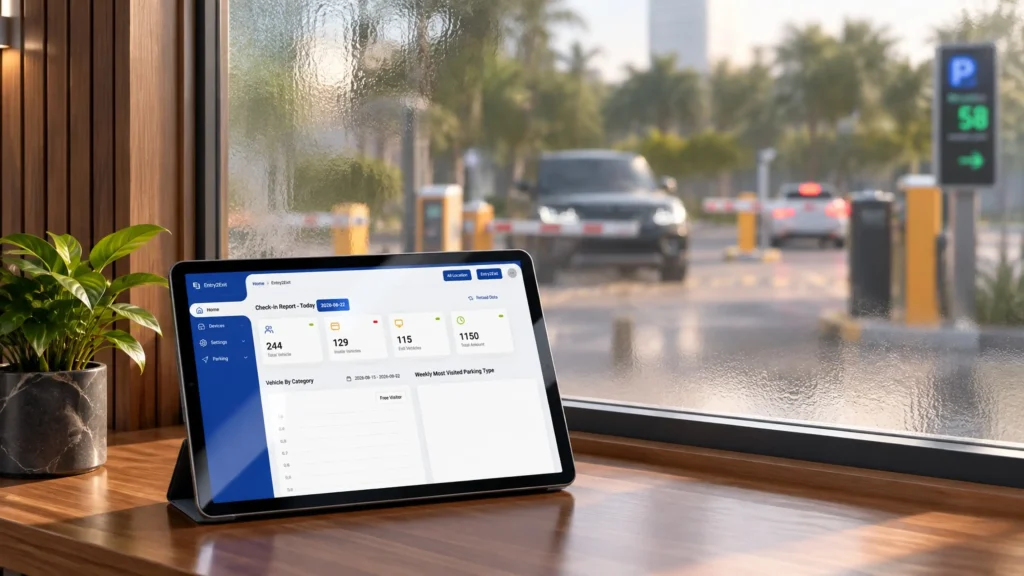
Entry2Exit integrates with ANPR cameras, boom barriers, access control systems, CCTV cameras, payment providers, and more to make all of this work together. The Entry2Exit system is essentially the brain of the parking lot. It connects with all the equipment and keeps track of every movement, every transaction, and everything happening inside the parking lot, so the operator understands what is going on at all times. They can pull reports, understand the type of vehicles coming in, and access logs whenever they need.
Parking Management and Guidance Systems
Beyond the physical structure of a parking lot, the real intelligence of a modern facility lies in the software and systems that run it. Let us break down the two main ones.
What Is a Parking Management System
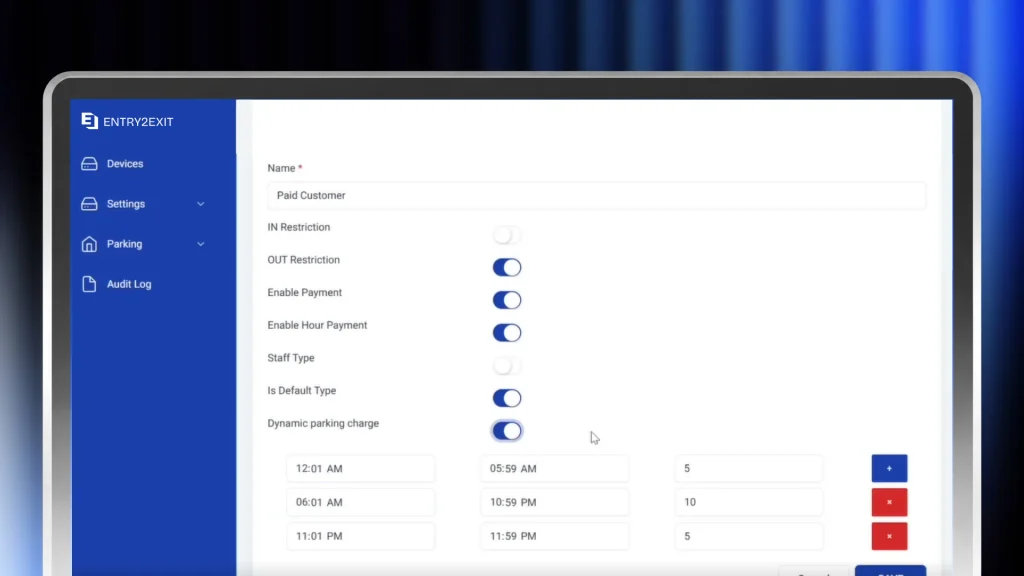
A parking management system, especially the Entry2Exit parking management system, is an end-to-end, fully automated operating system for a parking lot. It makes entry, parking, payment, and exit a memorable and quick experience for the customers and anyone using the system.
The Entry2Exit parking management system works as the brain of a parking lot. It uses ANPR cameras, automatic boom barriers, parking payment systems like tap and go or QR code mobile payments, and other add-ons like EV charger units for extra revenue. It automates the complete parking journey.
Here is an example. If you are a driver entering an Entry2Exit parking lot, you are first met with a closed gate barrier that opens instantly when you get close to it. Your car’s number plate is automatically captured by the ANPR camera pointed outwards. You drive in and park in whatever spot you like, then go about your business.
When you come back, you can scan a QR code placed around the parking lot to pay for the parking. You will be asked for your car’s number plate during the payment process. Once you pay and head towards the exit, the boom barrier automatically opens after the ANPR camera scans the plate at the exit. It happens in a split second with no waiting.
You also have the option to pay at the kiosk near the exit gate. If you reach the exit gate without paying, you can use the kiosk, which has a few payment options:
- QR code displayed on the kiosk
- Tap and go with cards or NFC-enabled mobile phones
- Mobile wallets like Apple Pay, Google Pay, Samsung Pay, or local payment providers
- Cash payment with a parking staff member who holds a portable cash collection device that also prints a receipt
After your payment, the gate barrier opens instantly and you can exit. That is essentially what an Entry2Exit parking management system is.
There are also a lot of custom integrations and add-ons available. For example, many of our commercial and retail customers go with an add-on called customer-validated parking. In this scenario, customers who have purchased something inside the business do not need to pay for parking because their purchase validates their visit. This is a popular option that a lot of shopping malls use nowadays.
What Is a Parking Guidance System
A parking guidance system is a wayfinding solution that helps drivers find the nearest free or available parking spot.
Imagine you are in a multi-level, multi-story parking lot that is very congested. Cars are going in and out constantly, and you will have a hard time finding a free spot. You have to drive through multiple floors manually looking for a space, turning your car in each floor, and if there are no spots, you have to move up again. This is a huge waste of time and it causes congestion.
This is where we propose the Entry2Exit parking guidance system. Before you even enter the parking lot, you are met with a parking display screen outside that shows exactly which floors have free spots, how many are free, and how many are occupied. So you know which floor to go to right away.
When you get to that floor, all you have to look for is the green LED indicator on the ceiling. If it is green, the spot is free. There are LED indicators with sensors above every parking space that detect whether a car is parked under them. If no car is there, it turns green. So you can quickly drive to that space.
On top of this, we can also add voice sensors, find-your-car modules, and other features to further increase customer satisfaction.
How They Work Together
A parking management system and a parking guidance system work together when customers want to provide drivers with a unique experience and a seamless parking journey. The parking management system takes care of everything related to parking the car, payment, and exit. The parking guidance system works as a wayfinding solution on top of that, providing extra convenience. Ideally, a parking lot should have both to offer maximum comfort to the drivers coming in.
Entry2Exit Differentiators
A few things that set Entry2Exit apart from generic parking software:
Local language support. We have the ability to integrate with custom languages based on the country or region you are operating in, which is important in the Middle East, Europe, and South Asian markets.
Multi-currency support. We work with multiple currencies, making Entry2Exit suitable for international deployments and mixed-currency environments.
Hardware-agnostic integrations. We work with a wide range of boom barriers and ANPR camera brands. Customers who already have existing barriers and ANPR infrastructure can switch to Entry2Exit without any friction. We are a company that promotes the use of existing infrastructure without adding extra cost to the customer.
Hardware and Equipment Used in Modern Parking Lots
Behind every smooth parking experience is a combination of hardware working together. Here are the main components you will find in a modern, automated parking lot.
ANPR Cameras
ANPR, or Automatic Number Plate Recognition cameras, are specialised cameras that capture and read vehicle license plates automatically. They are the backbone of modern parking because they replace the need for paper tickets, key cards, or manual entry logs. As soon as a car approaches the gate, the ANPR camera reads the plate, matches it against the database, and decides whether to open the barrier.
Modern ANPR cameras are accurate even in challenging conditions. Infrared variants can read plates at night and through dust, fog, and rain. Compared to RFID cards or ticket-based systems, ANPR is much more seamless because the driver does not have to do anything. The car itself is the identification.
Boom Barriers and Gate Barriers
Boom barriers are the physical gates that open and close to allow or block vehicles from entering a parking lot. There are a few different types. Straight arm barriers are the most common and work well where there is enough overhead clearance. Folding arm barriers are used in locations with low ceilings, like basement entries, where a full straight arm would not fit. Fencing arm barriers add a grille underneath the arm to prevent people from walking or crawling under it, which is useful in high-security locations.
When choosing a boom barrier, the most important things to look at are speed, durability, and MCBF (mean cycles between failure) rating. High-traffic parking lots need barriers that can open and close in under a second and handle millions of cycles without breaking down.
Kiosks and Payment Stations
Kiosks and payment stations are mostly used at the exit of parking lots, where people can pay for parking. In Entry2Exit, the kiosk and payment station is directly connected to the brain of the parking lot, which is the Entry2Exit software. It ensures that every car is accounted for, every payment is collected properly, and the barrier is opened after payment is complete.
The physical kiosk usually has a touchscreen. In some cases, it also has an intercom for fully automated parking systems where a remote staff member can assist drivers if they run into any issues. The kiosk can display QR codes, parking fees, print receipts, and handle all sorts of features depending on how it is configured.
Ticket Dispensers
Ticket dispensers are not really relevant nowadays, because ANPR-based fully automated parking systems have replaced them. Ticketless parking is what everyone prefers now. It is also much easier to maintain than ticket dispensers and more cost-effective.
When you consider that ANPR cameras and boom barriers combined with the Entry2Exit system will collect payment for every car without missing any, the extra investment in automation makes complete sense compared to the old ticket-based approach.
Loop Detectors and Ground Sensors
Loop detectors are wire loops embedded in the road surface near the gate that detect when a vehicle is present. They are used to trigger the ANPR camera and the barrier opening, and to confirm that a vehicle has safely passed through before the barrier closes again. This prevents the barrier from coming down on a car.
Ground sensors do a similar job in parking bays, detecting whether a car is parked in a specific spot. These are often used as part of a parking guidance system.
CCTV and Security Cameras
CCTV cameras are essential for any parking lot, both for security and for dispute resolution. If a driver claims they never entered the parking lot or that their car was damaged while parked, CCTV footage gives the operator the evidence they need. Modern parking lots integrate CCTV directly with the parking management system so that every event, from entry to exit, is linked with video footage.
LED Displays and Signage
LED displays are the big screens you see at the entry of parking lots showing things like “Floor 2: 45 spots available”. They are part of the parking guidance system and make life much easier for drivers. Smaller LED lights above individual parking bays, usually red or green, tell drivers which specific spots are free. This cuts down search time dramatically and improves the flow of traffic inside the parking lot.
Parking Sensors
Parking sensors come in two main types. Ultrasonic sensors, mounted above each bay, measure the distance to the floor and detect when a car is parked underneath. Camera-based sensors use computer vision to monitor multiple bays from a single camera, which can be more cost effective for large lots. Both feed real-time occupancy data into the parking guidance system so the LED indicators and displays stay accurate.
EV Chargers
EV chargers are increasingly becoming standard equipment in modern parking lots. They come in two main varieties. AC chargers are slower, typically used for overnight parking or long-duration parking. DC fast chargers are much quicker, suitable for quick top-ups in commercial and public parking. Entry2Exit integrates with EV charger billing, so the cost of charging can be added to the parking fee and collected together at the exit.
Intercoms and Help Points
Intercoms are installed at entry gates, exit gates, and kiosks to let drivers talk to a remote support team if they run into any issues. A driver might need help if the ANPR fails to read their plate, if they cannot complete a payment, or if they are simply confused about where to go. With an intercom, a support agent can solve the problem remotely and open the barrier if needed, without having to send someone on-site.
Other Hardware
A few other items commonly found in a well-equipped parking lot:
- Speed breakers to slow down vehicles inside the lot for safety
- Tyre killers and road blockers used in high-security parking lots like embassies or government buildings to physically stop unauthorised vehicles
- Bollards to protect pedestrian zones, pillars, and building entrances from accidental collisions
- Wheel stoppers placed at the front of each bay to prevent cars from pulling in too far
- Convex mirrors at blind corners, ramps, and tight turns to help drivers see around bends
Use our Parking Fee and Revenue ROI Calculator to get an estimate on the investments and returns a parking system can generate.
How to Choose the Right Parking Type for Your Property
There is no single right answer for every project. The right choice depends on a few key factors.
Available land. If you have plenty of land, surface parking or a large multi-story car park might make sense. If land is tight, underground, rooftop, or automated systems like stack or tower parking will give you more capacity in less space.
Budget. Surface and ground floor parking are the cheapest to build. Multi-story and underground parking are more expensive. Automated parking systems require the highest upfront investment but pay off through land savings and reduced operating costs.
Expected traffic. A small office might do fine with a simple surface lot, but a shopping mall or airport needs a combination of multi-story parking, a parking management system, and a parking guidance system to handle peak flow.
Target users. Residential buildings typically need assigned spots and some guest parking. Retail needs easy access and fast in-out. Hotels benefit from valet and VIP parking. Hospitals need clearly marked disabled and emergency parking.
Urban or suburban. In dense cities, space efficiency matters more than anything, which pushes developers towards automated or underground solutions. In suburbs, open surface lots are usually the most practical.
Safety and security. High-security properties like government buildings, embassies, and corporate HQs need ANPR, boom barriers, tyre killers, and integrated CCTV. Residential villas might only need bollards and basic access control.
The best projects usually combine multiple parking types. A shopping mall might have basement parking for cars, rooftop parking for overflow, valet parking for VIP customers, and a parking management system tying it all together.
Wrapping Up
Parking is a much bigger topic than most people realise. From a simple villa garage to a fully automated tower parking system with robots and AI, the range of options is huge. Choosing the right setup depends on your land, your budget, your users, and your long-term goals.
If you are a property developer, facility manager, or business owner looking to set up a new parking lot, or upgrade an existing one, Entry2Exit can help. We provide parking management systems, parking guidance systems, ANPR cameras, boom barriers, kiosks, and everything else you need to run a modern, automated parking operation. Whether you have an existing infrastructure you want to integrate with, or you are starting from scratch, our team can put together a solution that fits your property and your budget.
To see how Entry2Exit can work for your parking lot, get in touch with our team for a free consultation. We have delivered projects across the UAE, Saudi Arabia, Oman, Qatar, Kuwait, and now parts of Europe, and we would be happy to talk through your requirements.