If you manage a parking facility or are planning to set one up, you’ve probably already realized that a parking lot is not as simple to run as it looks. There are vehicles coming in and out at all hours, payments to collect, security to maintain, and staff to manage. When any one of these breaks down, it shows immediately. Revenue leaks. Customers complain. Incidents happen.
Over the years of working with parking facilities across the UAE and the wider region, from corporate campuses and residential communities to shopping malls and hospitality properties, we’ve seen the full spectrum of how parking operations can go wrong, and more importantly, how the right system can fix most of it before it even becomes a problem.
The most common thing we hear from facility managers before they implement a system is: “We didn’t think we needed this until things got out of hand.” Whether it was vehicles exiting without paying, unauthorized cars occupying employee spaces, or staff manually managing boom gates during peak hours causing long queues, the problems are almost always the same. What differs is how long they were willing to tolerate them.
A parking access control system isn’t just about putting a barrier at the entrance. It’s about having full visibility and control over your facility, knowing who is inside, for how long, whether they’ve paid, and whether they’re supposed to be there at all. Done right, it also removes the dependency on manual processes and the human errors that come with them.
This guide covers everything you need to know about parking access control, the types of systems, the components involved, the benefits, and what to think about before you implement one. Whether you’re evaluating options for the first time or looking to upgrade an existing setup, we hope this gives you a clearer picture of what’s possible.
Why PARKING ACCESS CONTROL IS IMPORTANT??
Parking lots are very prone to trespassing and the loitering of uninvited people all the time, especially when some parking lots are operating under a time frame. It is very common that some people still hang around after the parking hours or enter before the parking opens. This makes way for loss of revenue, unknown activities occurring in the premises, and other security vulnerabilities. While trespassing and loitering mainly affect the parking lot administration, there are vehicle break-ins and theft that could directly get the customers who use the parking lots involved. This is a major area of risk.
In the U.S. alone, about 880,000 vehicle thefts are reported annually. This is apart from the break-ins. Break-ins could cause reputation damage and loss of customer trust for the parking lot. This could result in theft of valuable items from vehicles that will get the customer directly involved, and it becomes a pain for both the driver and the parking lot admins.
While CCTV cameras are a great option to start with, they don’t prevent parking lot risks. By placing a CCTV camera that covers the whole parking lot, you can identify culprits or get footage of incidents when an event occurs, but it is not suitable to prevent the incident before it happens. That’s where parking access control comes into place.
What Is a Parking Access Control System?
The parking access control system is a system of hardware plus software that controls and manages the entire process of who can enter and exit a parking facility, when they should be allowed to enter and exit the facility, and how they can access the facility. Each and every entry and exit is logged into the system or the server with date, timestamp, vehicle number plates, sometimes the driver name and details, thus creating an audit trail for security and compliance purposes.
One advantage of such a system is that it is a centralized management system, meaning all the entry and exit points are controlled through one single platform. This creates little to no chance of errors and it is also very easy to be managed by one single person.
A parking access control system usually has multiple hardware installations. These can enhance the software’s capability of controlling access in very high detail. Apart from access control, the parking systems available on the market can sometimes integrate with payment systems, surveillance systems, HR systems, building management systems, and guidance systems. It is also possible to make the parking lot a fully automated one where no staff is required at the lot at all. This can reduce the dependence on manual security, and parking lots can save the cost of security guards, payment collectors, and other operators at the parking lot.
Types of Parking Access Control Systems
There are six different types of parking access control systems. These different types are suitable for different purposes. Let’s get into them one by one.
1. Barrier-Based or Boom Gates
In parking access control systems operated using barrier or boom gate-based systems, a physical arm that looks like a pole blocks the entry and exit until various steps are validated. These steps may include the capturing of the number plates at the entry and the validation of payments at the exit. This provides better security than just equipping the parking lot with CCTV cameras. These barrier gates are fully automated, meaning there is no requirement for staff to open or close the gates. The server communicates with the software and the barrier to open or close the gates accordingly. This also requires very low electricity than it may seem.
2. ANPR-Based Systems

In ANPR-based systems, an ANPR-integrated parking access control system uses an automatic number plate recognition camera to capture the number plate of the cars at the entry and exit. When a car comes into a parking lot, the camera captures its number plate in a split second and saves it into the database. While exiting, the software ensures that the car has completed the payment before it is allowed to exit. This is done through the ANPR camera mounted at the exit.
The access is controlled with the help of a gate barrier, as explained above. If the entry and exit are placed parallel to each other, a bidirectional ANPR camera setup can be used. If the entry and exit points are in different areas of the parking lot, separate ANPR cameras can be mounted. The ANPR cameras should be set up according to the elevation, the position of the cars, where they stop, the lighting conditions, and several other factors. These are to be carried out by experts in order to get maximum accuracy. This number plate data can further be used for whitelisting or blacklisting users inside the database.
3. RFID or Credential-Based Systems
These are used mainly on residential parking lots or parking lots in gated communities where each resident is given an RFID tag or a user credential. These RFID tags can be cards or mobile-based apps for providing the user with entry access. This ensures only the residents of the community are given access to park. The RFID tags or credentials can be issued by the administrator of the residential complex or whoever is in charge, very easily through the system.
Such RFID or credential-based systems are also popular for employee parking, student parking, etc. They can be further customized with maximum hours each RFID or credential can park in a month, allow or disallow overnight parking, whitelist or blacklist users, or provide access only to subscribed users. This kind of system involves the process of scanning the RFID or the credential through an app, either with a staff member or through an automated kiosk, for a seamless, streamlined experience.
4. Ticket-Based Parking
Ticket-based parking access control systems are operated with the help of a paper ticket or a digital ticket. On entry, such a ticket is issued, and while exiting, the ticket has to be paid according to the pricing tariff the parking lot has fixed. Such systems can track the duration of the parking and can enable dynamic pricing based on various factors such as the timing, the type of vehicle, the type of visitors, or other parameters. For example, overnight parking could be on a different tariff than office-hour parking. Ticket-based systems often require humans in the loop as parking lot staff, payment collectors, or barrier operators.
5. Remote or Cloud Gate Control
This type of parking access control system is used primarily for company parking or where guests and pre-registered visitors come to park their cars. The process involves a staff member managing the gates from a dashboard or a phone in order to open or close the gates after verifying the visitor. Sometimes a human will be in the loop to verify the cars manually. This provides a personalized welcoming experience for visitors while also maintaining the security that the facility requires.
6. Video Intercom
Video intercom parking access control works through a staff member who is present at all times, where customers can interact with the staff through the intercom. Visitors can press the intercom button on entry. Staff will visually verify and remotely open the gate for them. This can be implemented on public parking lots as well as company or residential community parking lots.
Intercom provides the experience of a real person assisting with the services while also cutting down the cost of having a staff member present in the parking lot at all times. This is a great choice if the parking lot has low to medium occupancy, because if occupancy reaches a higher level, a fully automated parking system or a manual system where a staff member is present would be preferable.
Essential Components of a Parking Access Control System
Barriers and Gates
Barriers and gates are the first point of contact for a driver. This is the first step where access is granted or restricted. Boom arm, sliding arms, swing, or vertical lift — depending upon the space and security level — can be considered.
Access Readers
Access readers are used for verifying the issued RFID cards, credentials, etc., as explained in the RFID or credential-based systems above. This is to verify if the visitor has a valid access permission to the parking lot.
ANPR Cameras
ANPR cameras are used to detect and log the number plates of the vehicles that enter and exit the parking lot. This is to cross-verify with the parking management system to understand the duration of the parking and to determine the fees based on the duration and other fixed parameters. ANPR camera logs can also be used for audit trail and compliance purposes.
Security Cameras
CCTV cameras can be used for security purposes inside the parking lot. These can be placed at areas where the visibility is low from the staff’s point of view.
Kiosk

A kiosk can be used for a variety of purposes like payment collection, ticket printing for ticket-based systems, intercom facilities, access card reading, etc. These kiosks can be integrated with parking management systems for providing a unified experience. These can be placed at the entry or the exit or any preferred area where the drivers can get easy access. Kiosks come in various different shapes and sizes that can be customized according to the parking lot’s requirements.
Parking Management Software
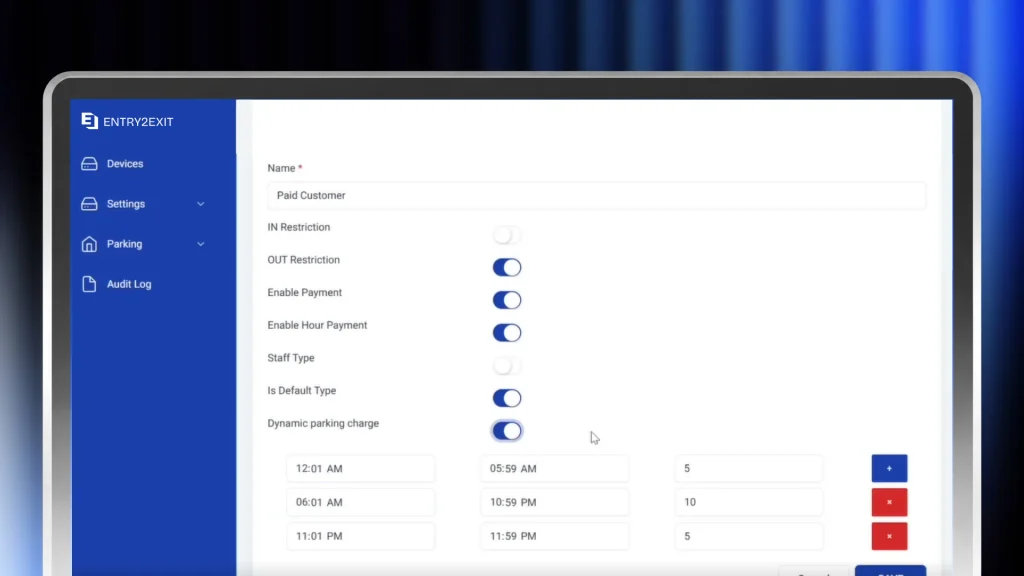
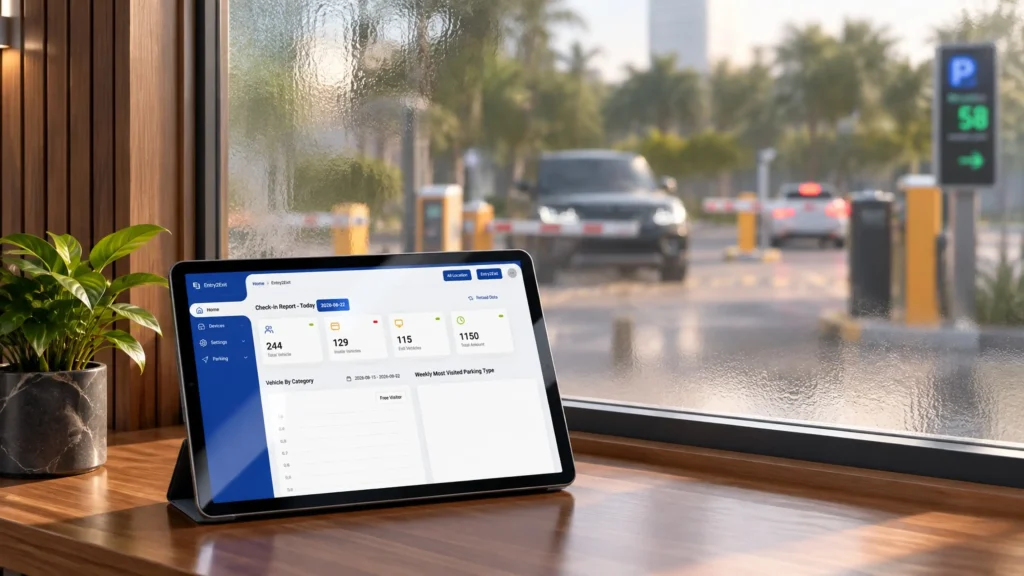
This is the brain of your parking lot. A parking management software takes control of all the hardware and other processes to act as a unified solution providing better customer experience and the reporting capabilities to the administration. The software is the control unit of the whole parking lot. This is where you customize your pricing, collect the revenue report, audit log, entry and exit data, and key metrics of the parking operations.
Entry2Exit parking management system is the best and leading software used for this exact purpose. Entry2Exit speaks with the hardware and the software side of things through the server to complete the various steps in a parking journey like entry, validation, and exit.
Payment Collection
For pay-to-park facilities, a payment collection module must be added in between the entry and exit points. This can be added on a kiosk for collecting payments through a QR code. In the Entry2Exit parking management system, we use a combination of all available payment methods:
- Tap-and-go
- Card payments
- Mobile wallet payments
- QR code scan
- Manual cash payment collection through a portable handheld device
A receipt is also given to the customer after the payment through the kiosk and the portable handheld device. This is ideally placed before the exit gate so that after the payment is confirmed, the exit gate is opened instantly, making way for the car to exit. The payment process of Entry2Exit is very smooth and fast, making the customer’s parking journey much quicker and seamless.
Parking Guidance Display
This is a large display that is placed outside the parking lot before the entry point to display the current occupancy of the parking lot, so that drivers can know beforehand if there is any space left. If it is a multi-story parking lot, it will also contain information on floors, so that the drivers can directly go to the floor where parking is available. It can also contain information like parking fees, rules, and other advertisements. Parking display monitors usually come in various sizes. The outside monitor will be a large weatherproof one, while the inside monitors for each floor will be compact ceiling-mounted displays. This display provides information drivers seek for easier access to the facility.
To understand how this differs from the parking management system itself, read our detailed comparison: Parking Management System vs Parking Guidance System.
Parking Information Hoardings
These are boards or hoardings usually made with plastic or metal where essential information like the tariff, operating times, terms and conditions, contact details, and other relevant information are printed. These are usually placed inside the parking lot as well as before the entry point.
QR Code Payment Displays
The QR code for parking payment will be placed at different areas inside and outside the parking lot. For example, if it’s a shopping mall, after parking, people usually go inside through a lift or an escalator. The QR codes for parking payments will be displayed across all these different entry points, prompting the driver to pay for parking, so that the drivers who are exiting from the shopping mall can easily pay for their parking by scanning the QR code and entering their license plate number. Such QR code images can also be placed at reception desks, lounges, and other areas where drivers could see them. This makes parking payments a seamless experience instead of a process that takes more than several minutes to complete.
Parking Guidance Sensors and Lights
Parking guidance sensors and LED lights are used to show available and occupied parking spots inside a parking lot. These are usually mounted on the ceiling adjacent to each parking space. If the light shines red, that means that space is occupied. If the light is green, it means it’s a free spot. If it is a large multi-floor parking area, it is ideal to include a parking guidance system to make wayfinding for the drivers easy. Drivers can just enter the facility and look for a green light on the ceiling where they can find the free spot.
This works with the help of sensors placed above each parking space. Sensors detect if a car is present or not under it. In the case of an open parking lot, the sensors and lights can be placed on the floor. Entry2Exit provides parking guidance systems, also enabling the lot managers the ability to fill the occupancy at a faster rate by removing the congestion at entry points as well as helping drivers eliminate confusion driving around to find an available spot.
Server

All kinds of software-based parking management systems or parking guidance systems operate with the help of a server. The server stores all the data and it helps to communicate with the hardware in the network. Entry2Exit provides on-premise servers as well as cloud servers that are either managed by Entry2Exit or managed by the client themselves.
Benefits of Parking Access Control
Parking access control provides a multitude of benefits for parking lot owners as well as the drivers who use these parking lots. Let’s understand how parking access control can benefit both of these cases.
- Stronger Security Since we are only letting in authorized vehicles, or vehicles are only allowed to enter after validating and storing their number plates, all blacklisted and unauthorized entries are blocked and stopped at the entry. This prevents the misuse of parking lots. For example, if it’s a pay-and-park lot, in the case of a vehicle where in the past they have exited without paying the fee, such cars can be easily detected using the number plate detection system. Or in the case of a private parking lot of a company, the company admin can prevent unauthorized access of people outside the organization from entering the parking lot.
- Faster Traffic Flow ANPR entry takes less than a second for capturing and validating the number plate. Along with that, the barrier gate opens or closes within a split second, making the traffic flow faster. In earlier times, when a staff member had to go and manually validate and open the gates for exit, it took anywhere from 2 to 5 minutes per vehicle. On larger parking lots, this became a bottleneck — where modern systems like Entry2Exit are redefining this process through our smart parking management system.
- Revenue Management Before smart parking systems were available, the revenue was calculated and collected manually. This opened the doors for errors, theft, unaccountability, and audit problems. But now, with parking access control systems, the revenue is collected and audited through the help of software. This removes the layer of errors and provides the customer with a fully transparent overview of daily, monthly, and yearly revenue dashboards, which can also be used to track performance over time. In Entry2Exit, all the revenue reports can be downloaded as CSV files for ease of usage. Such reports can then be utilized for auditing and taxation purposes. You can also use our Parking Fee Revenue & ROI Calculator to estimate returns before implementation.
- Operational Savings Smart parking systems opened the way for reducing overheads by staffing only one or a few staff members for the whole parking operation. Entry2Exit also provides the capability of a fully automated parking solution end-to-end, which means everything from entry, collecting payments, and exit can be fully autonomous through our advanced technology. This can help reduce the cost of staffing by up to 70 to 100 percent.
- Data and Insights Parking access control opened a plethora of analytics capabilities to get insightful data on occupancy, peak hours, zone usage, floor usage, revenue, staff performance, payment performance, etc. These can be utilized for staffing decisions, marketing purposes, and space planning.
- Superior User Experience Parking access control provides touchless and ticketless entry and exit, the ability to pre-book slots, the ability to pay for parking in an instant, reduced waiting times, and access to all information through a parking mobile application. These features make the experience of the users who access the parking lot far superior to parking lots without such a smart system. The real success of a parking lot lies in the retention of customers and increasing new customers alike.
- EV Charger Integration This is the era of EV vehicles. EV cars are now occupying about 15 to 25 percent of the road traffic in countries where there is a strict EV-focused push from the government. EV vehicles are growing much faster, thus helping the environment. In such times, it is important that the facility provides the ability for EV vehicles to be charged. Some very few smart parking systems like Entry2Exit provide this capability. By integrating EV charging units with the parking lot, you can open an additional revenue source by letting users charge. This can not only increase the revenue but also provide a competitive edge over other commercial parking lots without an EV charger integrated. We are getting a lot of such requests from industries like hospitality, real estate, and commercial parking lots for integrating the Entry2Exit parking management system with EV chargers. This is a growing space and we are certain that 90%+ commercial parking lots will be equipped with EV chargers in the next five years.
Get Started With The Leading Parking Management System Today.
Entry2Exit installs and helps manage smart parking systems for commercial buildings, malls, hospitals, and public facilitie. Setup is fast and the system runs itself.
ANPR vehicle recognition
Automated barriers
Digital payment integration
Parking analytics dashboards
Ticketless entry and exit
Remote monitoring and alerts
Things to Consider Before Implementing a Parking Access Control System
The first thing you will have to understand is that access control is not a set-and-forget system. It needs regular audits in order to catch security issues and vulnerabilities before they become an incident. The logs have to be reviewed periodically, ideally once a month, to look for anomalies like whether cars are exiting without payments, whether unauthorized cars are being parked, whether the revenue and the occupancy are matching, and whether the vehicles parked are aligning with the access control rules that you have set. This review will provide you with a complete picture of how parking operations are going in your facility.
The users of Entry2Exit parking systems generally do not face any of these issues as our system is a completely autonomous one, providing you with logs in real time, meaning staff can check on a daily basis if everything is going smoothly.
Another major area of consideration should be the permissions and roles. Before implementing a system, you should understand your user base, what are the different users who would access your parking lot, and what are the different rule sets you want to apply for each. For example, if your parking lot is a public as well as an employee parking lot, you will have to identify who are all the employees that require parking, how many spaces should be allocated to them, what are their timings for free parking, and how do you want to validate them. Is it going to be a license plate-based validation or an RFID or a credential-based validation?
When you are providing public access to your parking lot, you will have to allocate necessary space for them to park. So what will be the parking space count? How much will the parking fees be? Is there dynamic pricing involved? Are you going to provide overnight parking? What type of vehicles do you permit? You will have to come up with rules and definitions for each of the different categories of users and review them before proceeding with the implementation.
At Entry2Exit, our team will assist you in this process throughout, so that you can have an easy transition from a manual-based process to a fully automated parking process. Check out the Entry2Exit-powered parking lots to see our system in action.
Frequently Asked Questions (FAQ)
1. How long does it take to implement a parking access control system?
The implementation timeline depends on the size of the facility and the type of system selected. For a standard setup with boom gates and ANPR cameras, Entry2Exit typically completes installation and commissioning within a few days to a couple of weeks. Larger, multi-floor facilities with parking guidance sensors, EV charger integrations, and payment kiosks may take longer. Our team handles everything from hardware installation to software configuration, so you don’t need a technical team in-house.
2. Can I integrate the parking access control system with my existing CCTV or building management system?
Yes. Entry2Exit is designed to integrate with existing surveillance systems, HR systems, and building management systems. If you already have CCTV cameras in place, we can assess their compatibility and integrate them into the unified parking management dashboard. This means you don’t always need to replace your existing infrastructure, we work with what you have wherever possible.
3. What happens if the internet goes down? Will the parking system stop working?
Entry2Exit supports both cloud-based and on-premise server deployments. For facilities that require high availability, we recommend an on-premise server setup so that the system continues to operate locally even if the internet connection goes down. Entry and exit logs, barrier controls, and payment processing continue to function seamlessly and sync with the cloud once connectivity is restored.
4. How do I manage employee parking separately from visitor or public parking?
Entry2Exit allows you to set up different access rules for different user categories within the same facility. Employees can be assigned RFID credentials or whitelisted by their number plate, with designated parking zones and time-based rules. Visitors or public users operate under a separate tariff and access layer. Both can be managed from a single dashboard without any conflict.
5. Is it possible to run a fully unstaffed parking lot with Entry2Exit?
Yes, and this is one of our most requested setups. Entry2Exit supports fully automated, end-to-end operations where entry, payment collection, and exit all happen without any staff involvement. ANPR cameras handle vehicle identification, kiosks handle payments, and the barrier gates are controlled by the system automatically. This is particularly popular for commercial parking lots, malls, and corporate campuses looking to reduce operational costs significantly.
6. How accurate are ANPR cameras, and what if the number plate is not read correctly?
ANPR accuracy depends heavily on the quality of installation, the camera angle, height, lighting conditions, and the position where vehicles stop all matter. When installed correctly by our team, Entry2Exit’s ANPR-integrated systems achieve very high read accuracy. In cases where a plate is not read correctly, staff can manually override from the dashboard, or customers can use the intercom or kiosk to get assistance. The system also logs every capture attempt, so anomalies are easy to identify and address.
7. How do I get a quote or see Entry2Exit in action before committing?
You can contact our team directly to discuss your facility’s requirements and get a tailored quote. We also have a list of Entry2Exit-powered parking lots you can explore to see real deployments, and our free ROI Calculator can give you an estimate of the potential returns, both linked earlier in this article.