
Digital transformation is changing how we manage people and spaces. Today’s workplaces are hybrid, mobile and more open than ever, so it’s natural to ask how you protect your staff without creating friction for guests. Two technologies usually appear in this conversation: visitor management systems (VMS) and access control systems (ACS).
Many people confuse them. Both tools help you protect a facility, but they serve different purposes. As a senior product specialist at Entry2Exit, the leading visitor management provider that integrates with access control brands like Suprema and others, I often explain the distinction. Let’s break down what each system does, where they overlap and how to decide what you need.
Quick comparison table
The table below summarises the core differences between visitor management and access control. To keep it readable, I’ve used short phrases rather than long sentences.
| Feature | Visitor management system | Access control system |
|---|---|---|
| Primary purpose | Manage and record external visitors and contractors | Regulate entry for authorised personnel |
| Main users | Receptionists, security staff, employees hosting guests | Facility managers, security teams, IT administrators |
| Scope | Sign‑in kiosks, pre‑registration, badge printing, host notifications and visitor logs | Locks, readers, credentials (cards, PINs, mobile, biometrics), controllers and software |
| Function | Collect visitor details, verify identity, issue temporary badges, track duration of stay | Grant or deny access based on credentials and permissions; enforce access rules |
| Interaction | Human-centric; often involves front‑desk interaction and guest experience | Largely automated; users present credentials at doors |
| Security level | Focuses on screening and auditing visitors; basic deterrence | Provides robust, scalable physical security with audit trails and alarms |
| Cost structure | Subscription or one time license per location/month plus tablet, printer and scanner hardware (This varies according to the requirements) | High upfront hardware ($600–$3,500+ per door) plus installation ($500–$2,500/door) and ongoing licensing |
| Best for | Offices, schools, clinics, coworking spaces, government departments hosting guests | Data centres, laboratories, multi‑tenant buildings or any environment needing strict physical security |
| Integration | Can integrate with access control to activate badges only after host approval | Often integrates with video surveillance, alarms and building management systems |
Note: Costs vary widely depending on vendor and features.
What is a visitor management system?
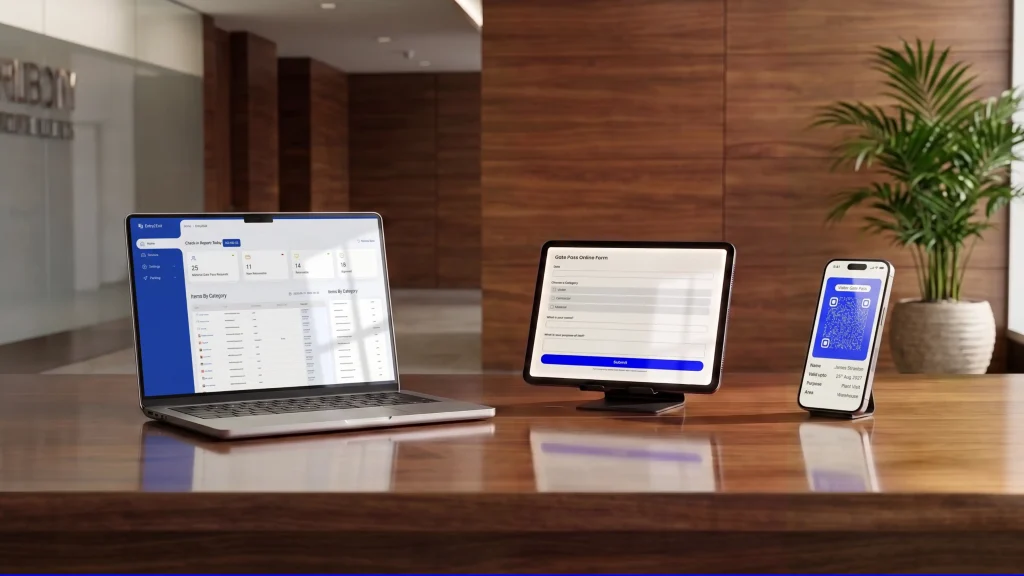
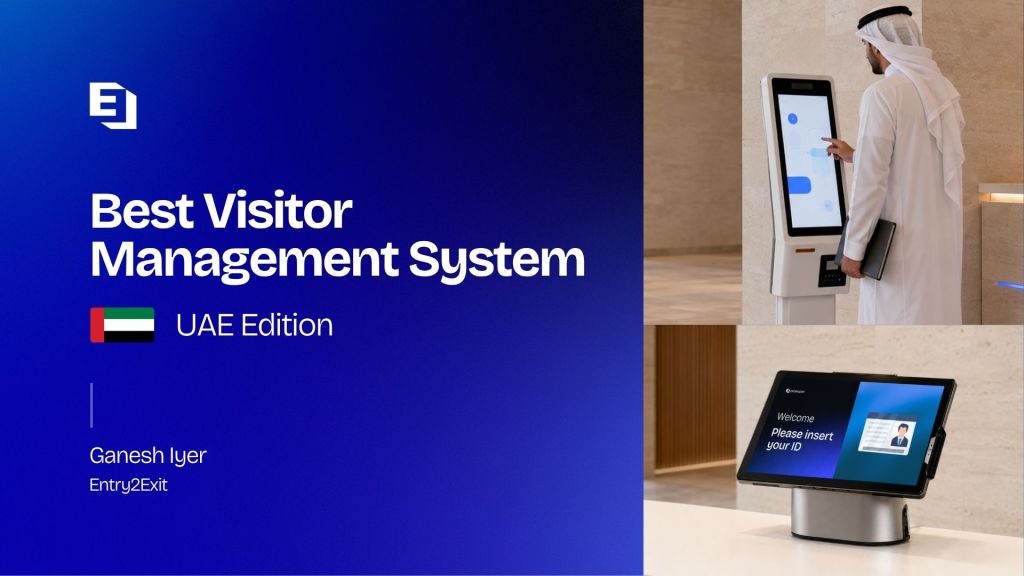
A visitor management system (VMS) is a digital tool that registers and tracks non‑employees who enter your premises. It records details such as names, contact information, reason for visit and sign‑in/out times. Instead of paper logs, guests sign in via a touchscreen kiosk or mobile link, often by scanning a QR code. Hosts are automatically notified when their guests arrive, and the system prints a badge with the visitor’s photo and expiry time.
VMS platforms offer many benefits beyond simple check‑in. They improve brand image by giving visitors a professional, contactless experience. They help manage office space by showing how many people are in the building and where they are located. Modern systems can pre‑register visitors, screen them against watchlists, collect signatures for NDAs and store digital logs for audits. By streamlining check‑in processes, they free front‑desk staff to focus on hospitality rather than paperwork.
Visitor management policies define who counts as a visitor: anyone who tries to enter your facility but isn’t part of your organisation. Visitors can include janitors, couriers, contractors, candidates or business partners. The importance of visitor management varies by industry: schools prioritise screening to keep children safe, while offices use VMS to prevent former employees or scammers from entering. In every case, the system helps you know who was on site if an incident occurs.
What is an access control system?
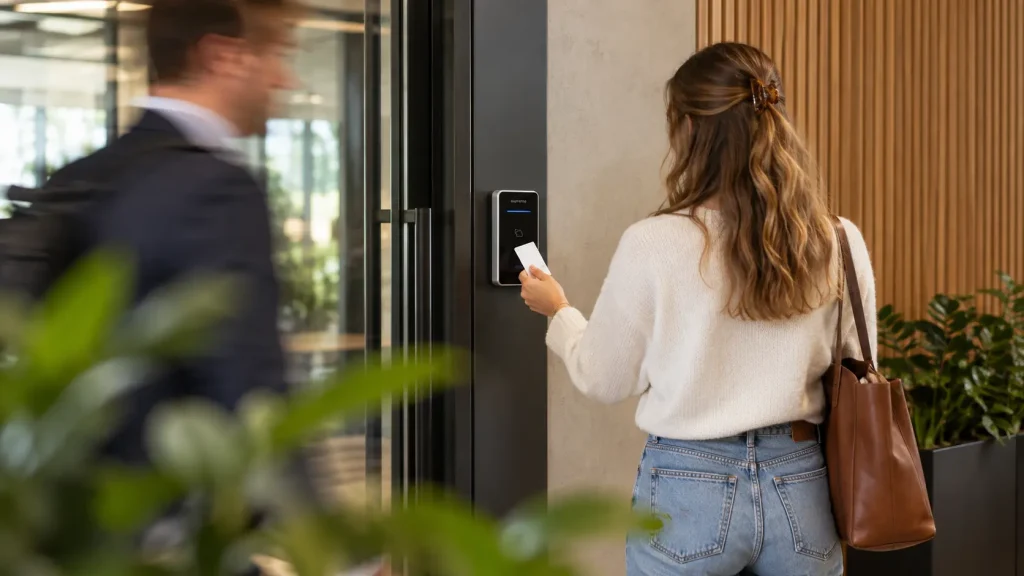
An access control system (ACS) focuses on who can go where and when. It regulates entry to buildings, floors or rooms using credentials such as cards, fobs, PIN codes, smartphones or biometrics. Access control systems enforce internal security by granting or denying access based on predefined permissions. They protect sensitive areas and assets by restricting entry to authorised personnel only.
Access control can be physical or logical. Physical access control manages entry to physical spaces; logical access control manages digital resources such as software or data. In this article we focus on physical access control. Typical components include:
- Control panel: the “brain” that makes decisions based on presented credentials.
- Reader: installed at each entry point, it scans a user’s credential (card, mobile or biometrics) and sends data to the control panel.
- Credentials: key cards, fobs, PINs, mobile tokens or biometric profiles that identify users.
- Release mechanism: an electric strike, magnetic lock, turnstile or elevator control that physically allows or denies entry.
Access control systems range from simple keypads to advanced biometric and facial recognition systems. They can be legacy, requiring on‑site servers, or cloud‑based, which store data and software in the cloud. Cloud-based systems are easier to manage remotely and integrate with other building systems but come with ongoing subscription fees.
Key differences between visitor management and access control
Purpose and scope
Visitor management deals with external people – guests, contractors, vendors and couriers. Its job is to answer the question “Who are you, why are you here and how long will you stay?”. By contrast, access control asks “Who is allowed to go where, and when?”. It ensures employees or residents have the right permissions to enter specific areas.
Interaction and experience
Visitor management often requires human interaction. Front‑desk staff greet guests, help them sign in and issue badges. The process is designed to be welcoming. Access control is largely automated: users present credentials at a reader and are granted or denied entry without assistance. Onfra notes that visitor management prioritises guest registration and tracking, while access control concentrates on granting or denying access based on set rules.
Security level
Access control systems offer a higher level of security. They integrate with intrusion detection, alarms and video surveillance. Visitor management provides essential screening and logging but doesn’t physically prevent someone from moving through the building. Without access control, visitors might wander into restricted areas after signing in. Without visitor management, you know who has a key card but not who is actually inside the building.
Integration
Both systems are most effective when integrated. Kisi emphasises that when visitor management and access control do not communicate, security breaches can occur: a visitor not approved by the VMS might still enter if the door is held open. Therefore, Entry2Exit integrates with hardware platforms like Suprema, Kisi and ButterflyMX. When a host approves a guest, the VMS can automatically activate a temporary access credential and deactivate it after checkout, ensuring visitors can’t roam freely.
Pricing – understanding the cost differences
Access control pricing
Access control systems involve significant hardware and installation costs. Kisi’s pricing breakdown indicates that the door reader and hardware range from $600–$1,500 per door. If locks aren’t already electrified, installation can cost $1,200‑$2,500 per door. Software licences typically cost $600–$1,600 per door per year. Overall, the average first-year cost for a single door is about $3,850.
Prices vary by system type. Keypad systems cost $1,000–$2,500 per door; key card and fob systems are $1,500–$3,500 per door with additional card costs. Mobile access solutions cost $2,000–$4,500 per door and often require subscription fees of $50–$150 per month. Biometric systems offer the highest security but can cost $3,500–$10,000+ per door, plus database management and calibration costs. Hybrid systems supporting multiple credentials cost $2,500–$6,000 per door. Installation fees typically add $500–2,000 per door.
Visitor management pricing
Visitor management systems use a subscription or one time license model with annual support charges. This is highly affordable than traditional access control systems. Plus, you are getting more features for the money you spend. This makes visitor management system a no brainer option compared to just using access control systems.
Why visitor management often costs less
Because VMS is software-based, most of the cost is tied to the subscription. There is no requirement to install heavy physical infrastructure at every door. For offices with a single entrance, visitor management can deliver strong audit trails and screening capabilities without the need for dozens of readers, controllers and electric locks. When combined with existing access control hardware, the overall cost remains lower than buying a separate access control system for each door.
Why visitor management IS the better option
- Improved visitor experience and brand image – A sleek sign‑in kiosk with your logo and a warm welcome leaves a better impression than a paper log book. Pitney Bowes notes that VMS helps create a positive visitor impression and demonstrates professionalism.
- Operational efficiency – Automated pre‑registration, sign‑in and host notifications reduce wait times and free staff to focus on core tasks.
- Compliance and audit trails – Digital visitor logs support audits, health and safety regulations and contact tracing. Data can be exported for regulatory purposes.
- Scalability and flexibility – Subscription plans allow you to pay for only what you need and scale up or down as visitor volume changes.
- Integration with access control – When integrated with a system like Suprema or Kisi, VMS can activate temporary passes only after host approval, ensuring visitors cannot access restricted areas.
- Cost-effective – VMS delivers most of the benefits of a secure check‑in process at a fraction of the cost of installing full access control on every door.
However, VMS is not a substitute for robust access control in high-security environments. If your organisation handles sensitive data, pharmaceuticals or government equipment, you still need a comprehensive access control system.
Who should use access control?
Access control systems are indispensable for:
- Data centres and research labs: Biometric or multi‑factor access ensures only authorised individuals can enter high-value areas.
- Healthcare facilities and pharmacies: Access control protects controlled substances and patient records.
- Financial institutions and government buildings: Regulatory requirements demand strict control over who accesses vaults, server rooms and archives.
- Large multi‑tenant buildings: Centralised access control manages hundreds of doors and users across different companies.
- Industrial sites: Factories, warehouses and energy plants require physical barriers and audit trails to meet safety standards.
In these environments, visitor management complements access control by providing screening, notifications and visitor logs but cannot replace physical security measures.
At Entry2Exit, we specialise in visitor management that integrates seamlessly with access control platforms. Whether you operate a coworking space needing frictionless check‑in, a school wanting to screen visitors, or a high-security facility requiring strict access permissions, the right combination of VMS and ACS will help you know exactly who is on your property and why. By understanding the differences and cost structures, you can invest wisely, protect your people and assets, and deliver a first-class experience for everyone who walks through your doors.
Frequently Asked Questions (FAQ): Visitor management vs access control
- What is the main difference between visitor management and access control?
Visitor management systems handle who is visiting and why they are on site. They collect guest details, issue badges and keep digital logs. Access control systems control who can go where by using credentials to unlock doors. In short, VMS manages non‑employees; ACS governs employee or resident access. - Can a visitor management system replace access control?
No. VMS provides screening and audit trails but doesn’t physically lock doors. Without access control, a visitor could still wander into sensitive areas. Combining the two ensures that only approved visitors can enter and only into designated areas. - Do I need both systems?
Many organisations benefit from both. Access control protects your facility at large; visitor management adds a layer of identity verification and hospitality. The two should communicate to prevent security gaps. - How much does access control cost?
Costs vary widely depending on the system. Expect to pay $1,000–4,500 per door for keypad, key card or mobile access systems and up to $10,000 per door for biometrics. Installation and licensing fees add $500–2,000 per door. - How much does visitor management cost?
Visitor management system prices varies according to the unique requirements of the customer. The software will have a standard price, then any additional customization requirements are charged separately. On top of this, there will be some hardware costs like Kiosks, Tablets etc. - Are visitor management systems compliant with data privacy regulations?
Leading VMS vendors provide GDPR-compliant data collection, consent options and data retention policies. You should choose a system that supports data privacy laws in your jurisdiction and integrates with single sign-on (SSO) or directory services. - Can visitor management integrate with my existing access control hardware?
Yes. Entry2Exit VMS offer integrations with providers like Suprema, Kisi and ButterflyMX. Once a visitor is approved, the system issues a temporary access credential that expires automatically. - Which industries benefit most from visitor management?
Offices, coworking spaces, schools, clinics and government departments use VMS to improve guest experience, maintain compliance and track occupancy. Any organisation that welcomes external people regularly can benefit from a VMS. - How do I decide which solution is best for my organisation?
Start by assessing your security requirements. Map your entry points and understand who uses them. If you need strict physical security, invest in access control. If your main challenge is tracking visitors and creating a smooth check-in experience, VMS might be sufficient. For most modern workplaces, an integrated solution offers the best balance of security and hospitality.