When it comes to managing a building’s overall security and accessibility, access control systems are always one of the key items required by most building management teams. A robust access control solution will provide the security and accessibility the building requires without much of a hassle.
Traditionally, management opts for just the access control system as a standalone solution, but recently we can see another trend emerging. For most buildings, an access control solution alone is insufficient. They need a visitor management solution as well. That’s when they think about integrating a new visitor management system into their existing access control systems.
These requirements can be complex. They can be multi-layered, and they can also involve many new processes and workflows that didn’t exist before. Even though it may feel complicated and time-consuming, you are almost guaranteed to have a better visitor experience for everyone accessing your building if you combine the two.
I am writing this blog because a lot of requirements we receive nowadays have elements of access control integration involved in them. Customers oftentimes may not know if such an integration is possible, or they might not know how a visitor management system and access control integration would work. This blog will guide you to understand how both systems work together as a unit, as well as the complete process behind integrating a visitor management system with access control systems.
What Is Visitor Management System Integration with Access Control All About?
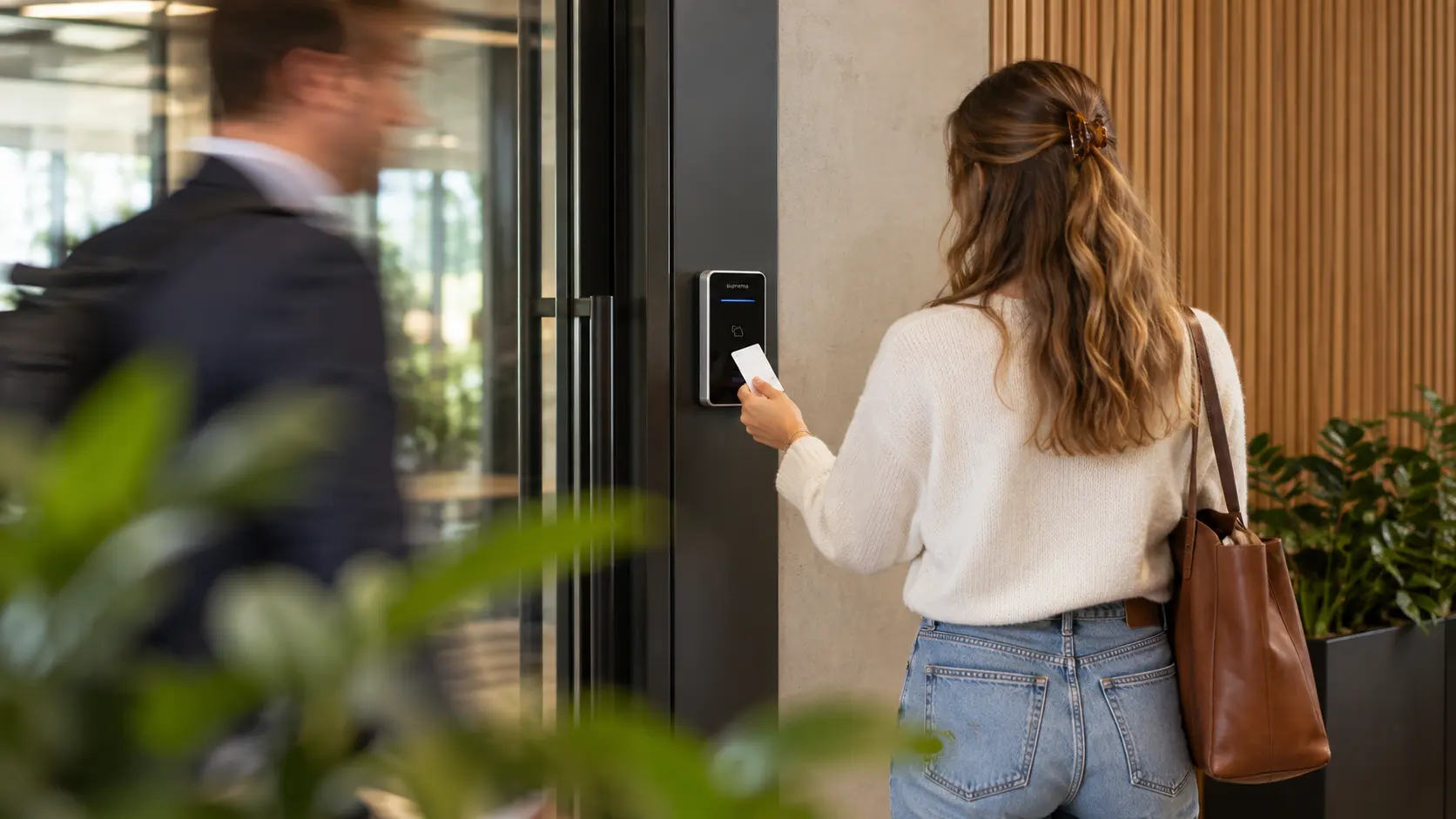
Let us begin by understanding the difference between the two. An access control system is an umbrella term that covers a lot of different things. For example, there will be access control software and access control hardware. The software will act as a layer that supports all the hardware and its configuration, while the hardware will enforce access to its deepest level, as required.
Access control hardware comes in different forms for different purposes. For example, there are:
- Controllers
- Readers
- Access cards
- Turnstiles
- Door locks
- Elevator panels
- Gate barriers
- And more
The purpose might be different for each. For an office building, a card reader or a biometric device might be sufficient, but for a public place, a subway turnstile will be required. For other types of buildings where heightened security is required, access control devices like secure door locks and gate barriers might be required.
The purpose is not only for the activities inside the building. It can also help with outdoor access control. Hardware like bollards or gate barriers helps in restricting or granting access to vehicles. This is just the tip of the iceberg. Access control solutions go much, much deeper than this, but I hope you understand the basic concept of what an access control solution might look like.
Coming to visitor management systems, a visitor management system primarily deals with the process of checking in, logging, managing, and checking out people. There are many types of visitor management systems, just like the many use cases of access control systems. For example, visitor management for a hotel would have different processes and modules than a visitor management system for a government office. The government office would require many more security features than a hotel or a public event.
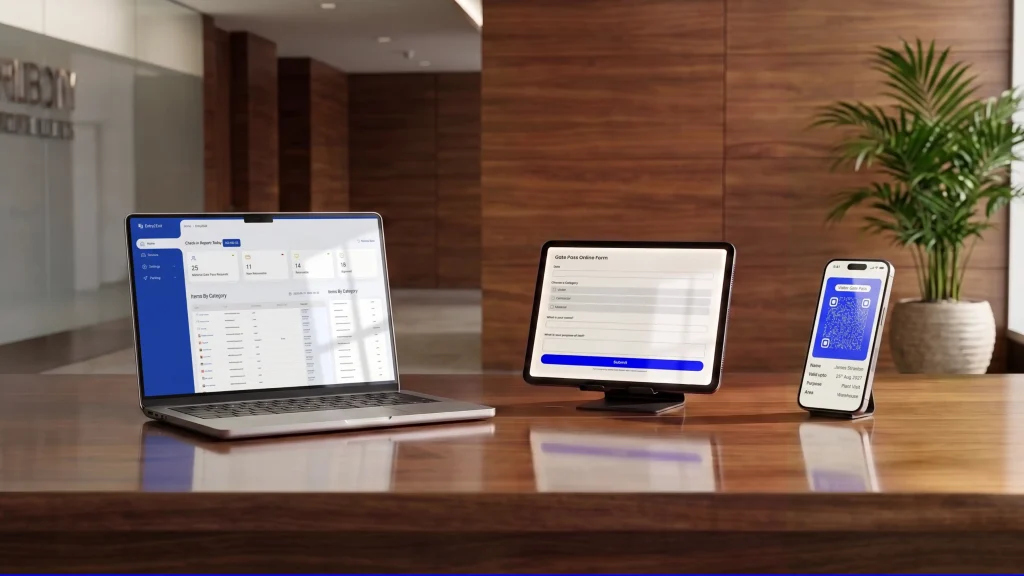
A visitor management system does not only track the visitors, but it also provides a secure and safe way of collecting the visitor data, preserving the data, and getting insights from the data. A visitor management system also has hardware as a part of it. The hardware range includes kiosks, tablets, printers, ID card readers, cameras, and several other devices.
Visitor management systems can be directly integrated with access control hardware, or they can also be integrated with access control software. In most cases, for a standalone visitor management system, the integrations will be minimal, but if the customer has an existing access control software layer or hardware, integrating it with the visitor management system is highly suggested.
The key part that separates visitor management systems from access control systems is that visitor management systems are the control panel for managing the visitor data across the whole building. They communicate with the access control system to let it understand whom it should give access to and whom it should not. As I said earlier, this does not only cover indoor processes. It also extends to outdoor processes such as parking.
For example, Entry2Exit has done a project for Star Energy, where they already had a Matrix access control system in place, but it didn’t have the robust visitor management capability that Entry2Exit provided. We came in and integrated Entry2Exit with Matrix Comsec to provide the customer with a much more robust visitor management mechanism, where they can restrict or grant access according to roles easily from one single dashboard.
Read our guide to the best visitor management systems before making the purchase decision to integrate with an existing access control solution.
Why Integrate Visitor Management with Access Control?
The problem with keeping visitor management separate from access control is a big one. Running both separately will cause problems when it comes to data tracking and also access issuance. For example, you give someone access to the premises on your visitor management system, but the turnstiles at the front door don’t know about this. What happens is that even though the person comes with a QR code that is validated by the visitor management system, or tries to scan his face to get access, the turnstiles won’t open for him. This is because those devices don’t have the data necessary to proceed.
Now, coming to the data flow between the two: if the data is being handled by separate systems without connectivity between them, you won’t have any idea how many people are currently inside the building, how many have exited, and how many are scheduled to come. It is necessary that both systems are connected together so that data can be uniform across all places. Otherwise, one system might show a different reading than the other, and it can cause problems.
There are several limitations to an access control-only requirement:
- The visitor data capturing will be incomplete without a visitor management system.
- The data captured by access control hardware might have errors due to typing or external factors.
- There won’t be a clear line of communication between the visitor and the host in case of a scheduled or pre-arranged visit.
- The logs won’t be as robust as the ones a visitor management system can provide.
- The customization of the processes will be limited to the access control system you choose.
- You may need multiple dashboards and multiple control panels for managing access across the whole building, including indoor spaces, multiple floors, and also outdoor spaces like parking.
These are some of the limitations if you only use an access control system. All of these limitations would completely go away if you introduce a visitor management system to the mix. One of the best advantages the visitor management system brings to the table is simplicity and clarity: just one dashboard showing all the visitor data, all the access control data, and all the settings and options you need to configure both systems under one umbrella. It is a must-have when it comes to managing a building. Juggling between systems not only affects your data accuracy, but it also sacrifices security and ease of use.
How Visitor Management and Access Control Integration Works, Step by Step
This section shows how a visitor management system and an access control system work as an integrated unit in a real-world, practical scenario.
I have to give you a heads-up, because this is just one of the sample requirements we have recently received. Depending on your individual processes and workflows, this can be a totally different scenario for you, but I have tried to encompass the core idea behind the integration. I have tried to keep it very simple so anyone, even without a technical background, can understand what happens in a real-life situation.
Imagine you are a host who has invited a visitor through the visitor management system dashboard by entering the visitor’s name, email, phone number, number plate, and maybe other identifiable data points like ID card details or more. This process itself has multiple options:
- You can send the invite yourself.
- You can send a link to the person, who can fill it out themselves.
- The visitor can go to your website and fill in all the details for a pre-registration.
- They can come to your office and use the kiosk for a pre-registration.
In all these methods, the steps are similar. Once the invitation is done, the visitor will get an email, SMS, WhatsApp message, or all of them together.
After the invitation is sent, the visitor management system also sends a temporary credential to the access control system. This credential will make sure that the right person is approved wherever the access control system restricts access or takes decisions.
After this, the visitor will come in the car that the host has already registered. The gate barriers to the parking will automatically open, which otherwise remain closed for outside visitors. Once he is out of the parking lot, he may proceed to the reception, where there can also be turnstiles or doors that restrict access for non-invited visitors but will open for the particular visitor you invited.
At the reception, the front desk staff will greet the visitor by his name, confirm other details, and guide him to the meeting with you. At the same moment the visitor arrives at the reception, you will receive a notification on SMS, WhatsApp, email, or all of them together, saying, “Visitor name has come to meet you” or “Visitor name is at the reception waiting for you.”
This can further be connected for approving or rejecting access to elevators, different floors, different zones or sections of the building, and based on roles. After he is checked out, the credential is removed automatically from all the access control devices using it.
Every step of the way is logged in one record by the visitor management system, stored on your cloud, on your own on-premise server, or on a managed cloud server by Entry2Exit. Now, the process may be different for each scenario. If there is a spot check-in option available, the process will be configured according to that. Also, this completely depends upon the security demanded by the building.
In this particular example, I have mentioned access control devices at the parking, while he is entering the building, on his way to meeting the host, and also during checkout. The types and processes of these devices can be customized, but each venue demands different solutions and devices. An access control device used at a public event might not be sufficient or secure enough to be used at a bank or an oil refinery. Each device will have its own scenario and tested ratings, so it’s very important to keep this factor in mind while installing the access control system itself.
How Visitor Credentials Work with Access Control
The Entry2Exit visitor management system can give visitors access through a wide range of options. The most popular one our customers ask for is a QR code. The reason is simple: a QR code is universal, it’s easy to use, and it has no additional hardware device costs associated with it. It can be integrated into almost any access control device, like turnstiles or doors. This can be utilized both for pre-registered guest check-ins and for events.
The second type of credential requested by many of our customers is face recognition. We use SAFR face recognition, which is already integrated with the Entry2Exit visitor management system. The face recognition module can store up to 1 million faces right on the device itself and offers split-second recognition rates, which are among the quickest in the whole world. Facial recognition credentials can be beneficial for frequent visitors, contractors, VIPs, or high-profile guests. Facial recognition terminals can be installed at the gates or turnstiles, or wherever the customer prefers.
Another popular credential method is the access card. Access cards can be temporary or permanent, based on the nature of the requirement. This is very popular with sites where only card readers are available. Card readers are generally cost-effective, and they provide a good amount of safety. For this, the hardware requirements will be existing or new card readers and card encoders at the reception.
Another type of credential that is getting popular nowadays is vehicle plate recognition, or ANPR systems. At Entry2Exit, we use ANPR systems. Visitors who come by car or in other vehicles can have great benefits with such a system. It means the barriers will automatically open for them without them stepping out of the car or needing to give their details by stopping at the parking gate. This is done through ANPR cameras located at the barriers. There is no need for a ticket or a card for this to work.
There are even more credential types, like biometric devices using fingerprints, barcodes, and more. I have only mentioned the most popular ones here, so if you are looking for one, please consider the other ones also.
How Do Visitor Management and Access Control Systems Connect?
Let me be honest: this section will be slightly technical, but you can get an idea of how the technology and integration work behind the scenes. The visitor management system and the access control system will be connected in one of three ways:
- Through the access control vendor’s API or SDK
- Through middleware or a database
- At the hardware level, where the visitor management system controls the devices directly
Among these options, we always prefer API integration because it is the cleanest and most efficient way to connect with access control systems. The other solutions mentioned here can be used if the access control system is closed or has older firmware.
Can a Visitor Management System Integrate with My Existing Access Control Brand?
In most cases, yes, meaning 99% of the cases. Entry2Exit is a brand-agnostic visitor management system that can integrate with any third-party software or hardware if the other party can provide the appropriate documentation and integration prerequisites.
At Entry2Exit, we are already integrated with more than 50 hardware and software solutions, and a large part of them are access control software and hardware, including software from Genetec, Matrix, Suprema, HID, ZKTeco, Honeywell, Lenel, Gallagher, and more. On the hardware side too, Entry2Exit is integrated with multiple leading access control hardware brands out there on their latest firmware.
The only requirement for us to integrate with your existing access control brand is to keep your access control device firmware up to date with the latest version. If you have an older model and you don’t have the necessary licenses for accessing the latest firmware, we can go with any of the other methods that I mentioned above.
Since this is a more technical area of concern, it would be ideal if you get in touch with our sales representative by clicking on the contact button. Our team will be happy to guide you to the best possible solution.
Where Is Visitor Management and Access Control Integration Used?
Visitor management and access control integration can be used wherever visitors need controlled access past the reception. Mainly, our customer base is using integrated visitor and access control systems at:
- Multi-tenant spaces
- Corporate headquarters
- Hospitals
- Industrial sites
- Schools
- Oil and gas projects
- Government buildings
Each uses the same visitor and access control integration, but with its own processes and workflows.
How Entry2Exit Integrates Visitor Management with Access Control
As I said above, Entry2Exit is a brand-agnostic visitor management platform that is already integrated with 50+ third-party software and hardware providers. We have done hundreds of projects where an aspect of access control was integrated with our solution. With the expertise we have in integrating our solution with many of the most popular access control brands out there, we have developed a leading voice in the visitor management space.
A few advantages Entry2Exit has in integrating our visitor management system are:
- We work on an open integration framework. We can integrate elevator doors, turnstiles, glass doors, barriers, fire alarm systems, and any other system, no matter what.
- We unify employees, visitors, tenants, and guests under one single platform, under one single umbrella.
- The credential types include QR, face recognition, ANPR, Bluetooth, card readers, and more.
- We provide unmatched capability when it comes to reading ID cards, including all of the GCC and European ID cards.
- We support three different deployment options: on-premise, private customer cloud, and managed cloud.
Frequently Asked Questions
1. Can a visitor management system integrate with any access control system?
The answer is: we don’t know about other systems, but the Entry2Exit visitor management system can be integrated with any access control system out there. We are one of the very few companies who can say this confidently.
2. Do I need to replace my access control hardware to add visitor management?
The answer is absolutely not. The Entry2Exit visitor management system can work with existing access control hardware and also the software layer to provide you with the complete solution.
3. How does a visitor get access without a physical card?
The answer is: there are plenty of options. A popular option nowadays is using a QR code. You can also use your car plate number, biometrics, face recognition, Bluetooth, and more. By the way, visitors can also use a mobile app to access the building.
4. Is visitor access removed automatically after the visit?
The answer is yes, and it’s optional. If the site requires that visitor access must be removed after each visit, we can definitely configure it that way. If you need the access to stay permanently or up to a certain period of time, that can also be done.
5. Can visitors be restricted to a single floor in the elevator?
The answer is absolutely yes. Wherever you want to give the visitor access, whether that is based on floors, zones, or locations, it can all be managed through the visitor management system dashboard itself.
6. Can parking barriers and ANPR be part of the visitor flow?
100%. About half of the requirements we receive nowadays involve at least one aspect of ANPR or parking-based access control integration, and we are experts in this particular field since we are also a parking management system provider.
7. What is the difference between my access control system’s visitor module and a full visitor management system?
It purely depends on the brand of access control. Most access control systems out there have a visitor module, which will work until it doesn’t. Visitor management is not their core focus, and it never, never will be. It may have the basic functionalities, but it won’t be able to meet your custom requirements or custom reporting needs. Entry2Exit, on the other hand, is a full-fledged visitor management system that can be customized, integrated with any system, and built around the process you currently have instead of making you fit into a different one.
8. Do ZKTeco, HID, or Hikvision work with third-party visitor management systems?
The answer is absolutely yes. We have integrated with all of these brands for different projects, and all were done through API or SDK. Both our teams have great connections and internal communication to make sure that the project is delivered in a timely and efficient manner.